TRADITIONAL SEARCH (GOOGLE)
- 10 organic results per page
- Average click-through rate: 2–5% p per position
- The user compares them manually
- Loss of attention after three clicks
- Competition from 10+ visible brands
- Advertisements everywhere



Help us prepare for our appointment





Every day, millions of users rely on ChatGPT, Perplexity, Gemini or Copilot to discover brands, compare offers and inform their decisions. These platforms are radically transforming the way brands emerge, are understood and are recommended. Without dedicated optimisation, you are missing out on major opportunities for visibility, credibility and preference. We help you secure long-term recommendations in these new conversational environments.
Between 2023 and 2025, search behaviour is changing rapidly. Conversational AIs such as ChatGPT, Perplexity and Gemini are gaining hundreds of millions of users, whilst Google is integrating AI into its search engine. Adapting your visibility strategy has become essential.

AIs synthesise information and only cite a limited number of sources. Without a GEO (Generative Engine Optimisation) strategy, organic visibility becomes a real challenge.

With the evolution of SERPs driven by AI, the cost of customer acquisition is skyrocketing. Only brands optimised for GSO are doing well.

Clicks from traditional results fall from 18% to 64%. A GEO agency can help you regain control over your visibility in AI-generated responses.

AI reformulates, aggregates and rebroadcasts your message. Without aligning your brand tone with AI systems, there is a real risk that your message will be diluted.
The difference between being visible and being invisible

Evaluate the perception of the brand by AIs and its positioning in relation to competitors, to identify the levers for improving visibility.
Identify and prioritise influential sites, media and sources that shape perceived authority, in order to strengthen presence in strategic spaces.
Analyse crawlability, indexability, tagging and technical compliance (robots.txt, sitemap, structured data) to remove technical barriers to visibility.
Create content that is clear, structured and semantically enriched, making it easier for LLMs to process, quote and distribute.
Develop mentions on reliable sources, strengthen presence in LLM databases and continuously monitor authority signals.
Our proven methodology combines technical analysis, content strategy and continuous monitoring to maximise your chances of success. Used by hundreds of companies, it aims to gradually build your presence in AI-generated responses.
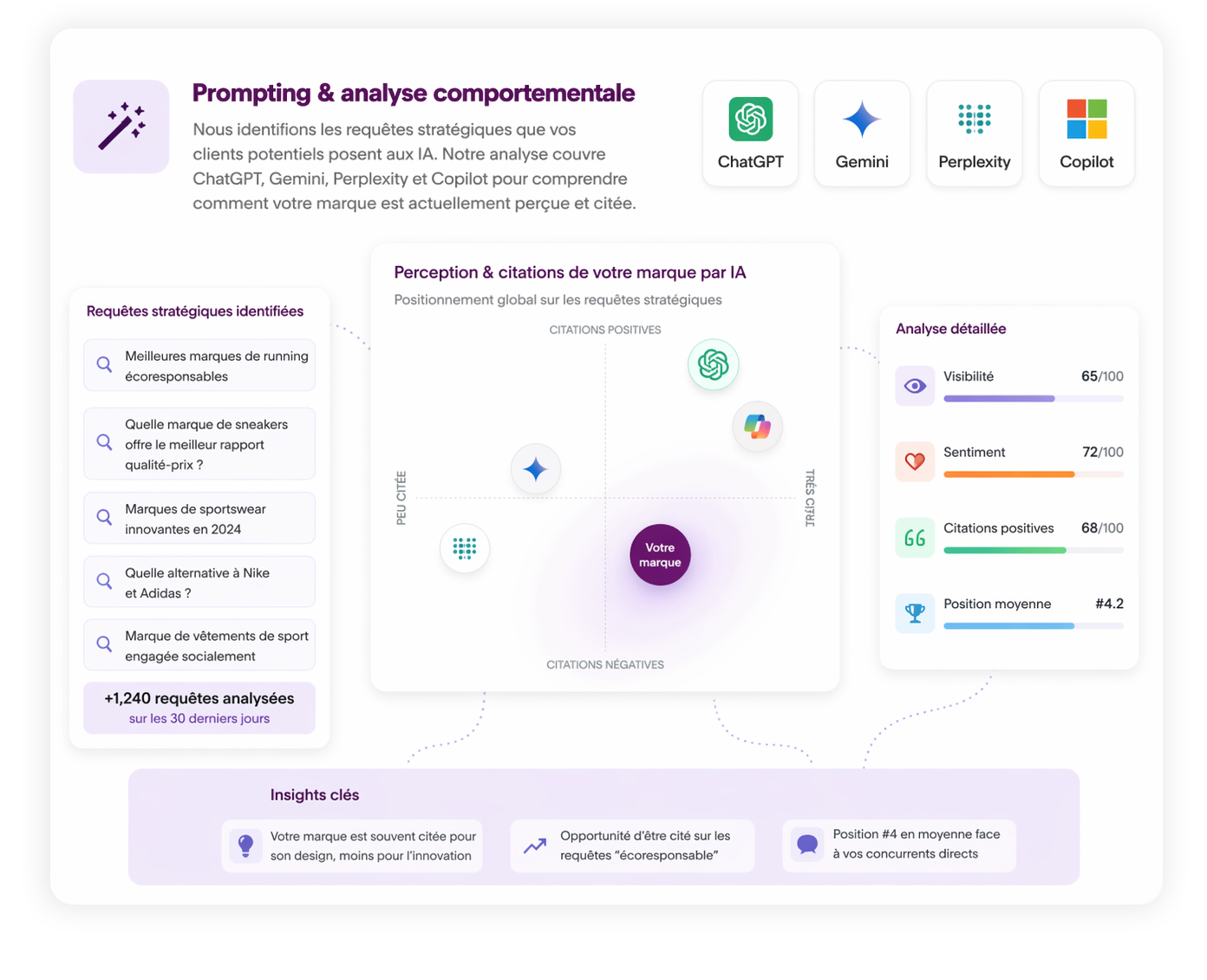
We identify the strategic queries that your potential customers are asking AI systems. Our analysis covers ChatGPT, Gemini, Perplexity and Copilot to understand how your brand is currently perceived and mentioned.
The analysis phase is critical: the success of a GEO strategy depends on the quality of this initial stage. We never start with assumptions, but always with real data derived from user behaviour on AI platforms. Understanding exactly how and why your brand appears (or does not appear) in AI responses enables us to build a precise and effective strategy.
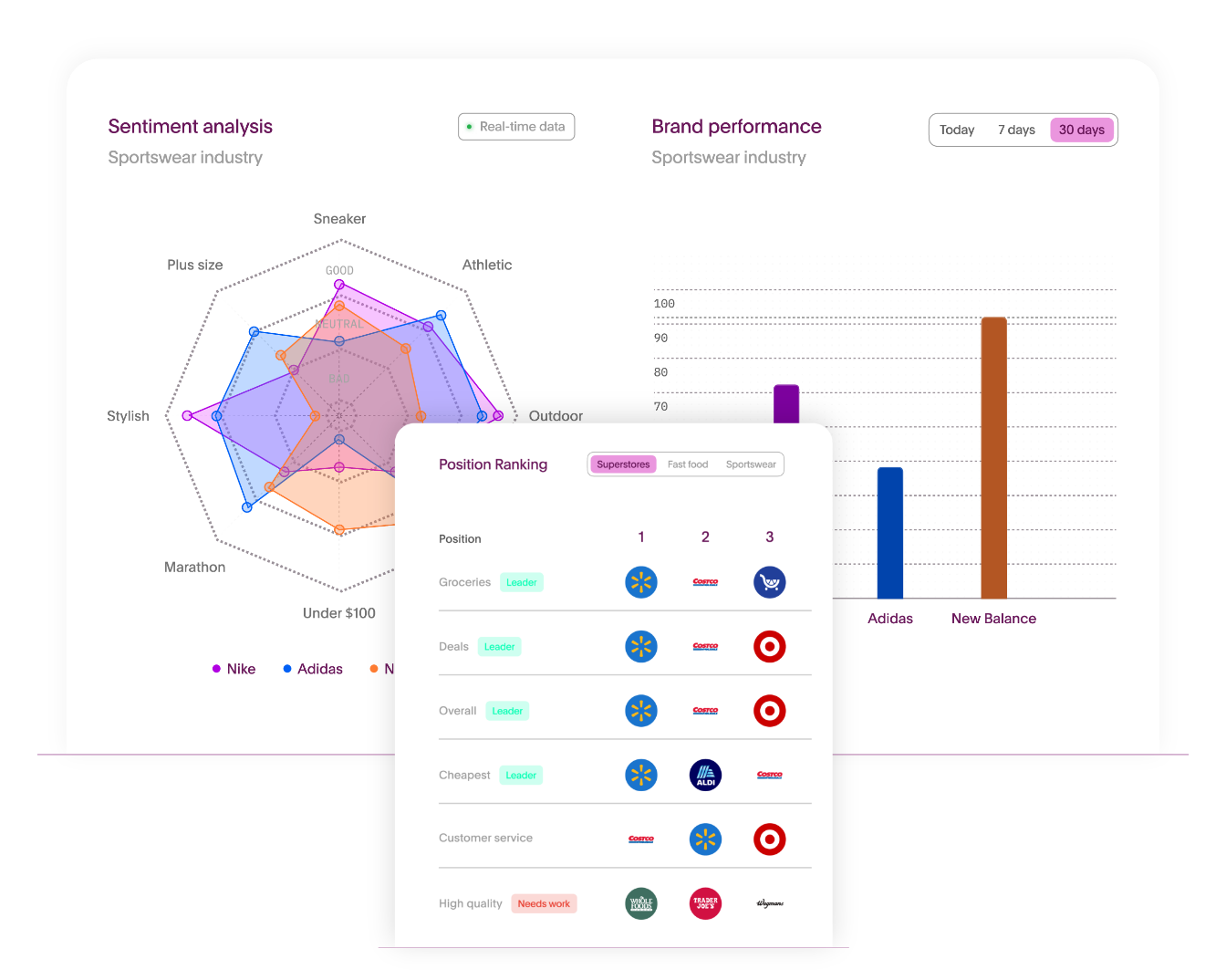
AI systems only cite sources they deem reliable and authoritative. We create a comprehensive heatmap of your sector’s digital ecosystem to identify where to strengthen your presence.
AI systems operate on the basis of consensus: the more your brand is mentioned across a variety of authoritative sources, the more likely it is to be cited. The key is not to be everywhere, but to have a strategic presence on the sources that large language models (LLMs) prioritise for your sector. A single article in a leading publication is worth more than 100 low-quality backlinks.
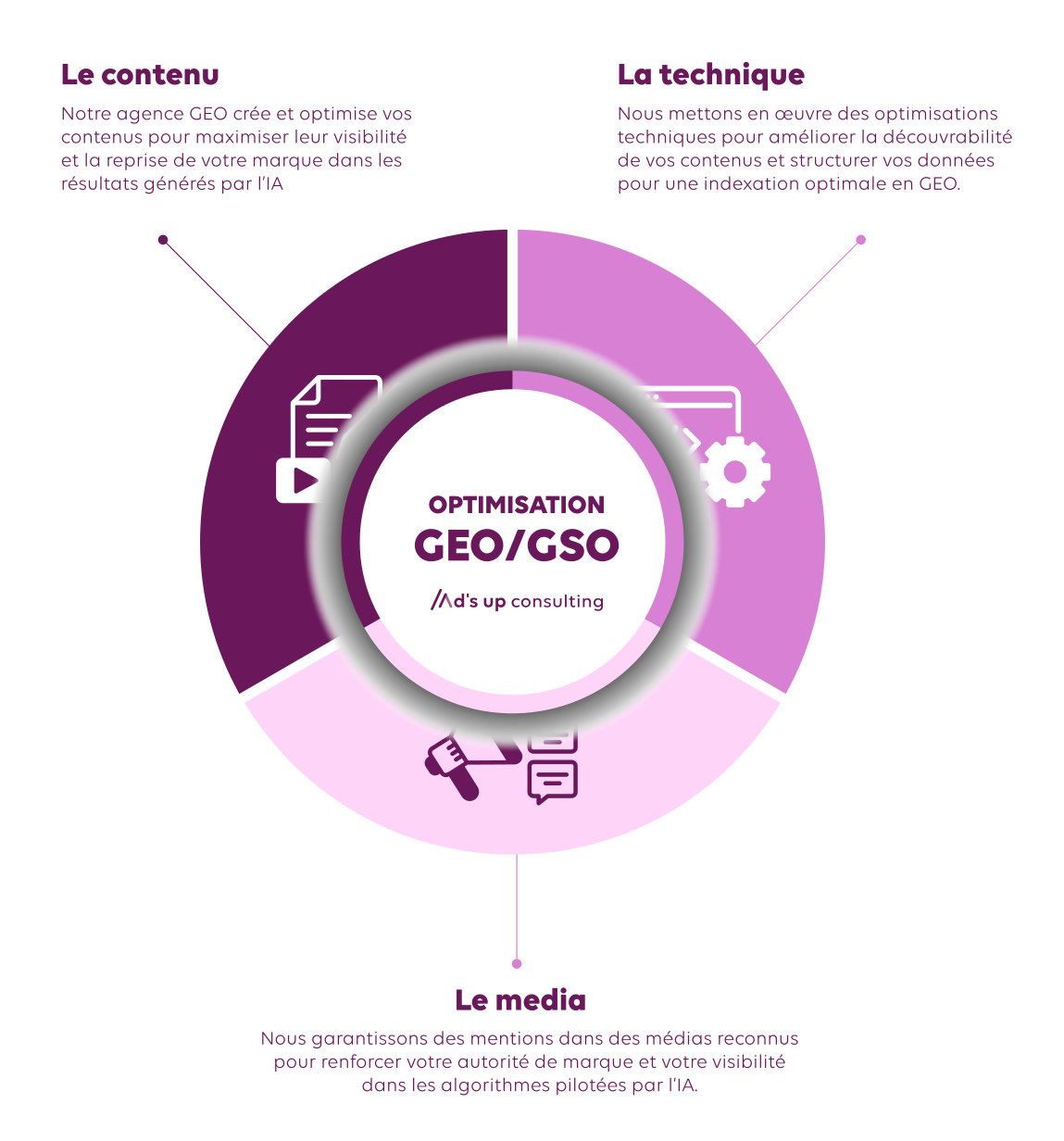
AI systems crawl and analyse your content differently from traditional search engines. Our technical audit aims to optimise your website and content so that they are better understood and potentially cited by large language models (LLMs).
Unlike traditional SEO, GEO does not rely solely on technical criteria. However, a clear structure, structured data and content that can be easily parsed by AI agents remain essential. Our audit identifies the technical barriers that could prevent large language models (LLMs) from correctly understanding and indexing your expertise.
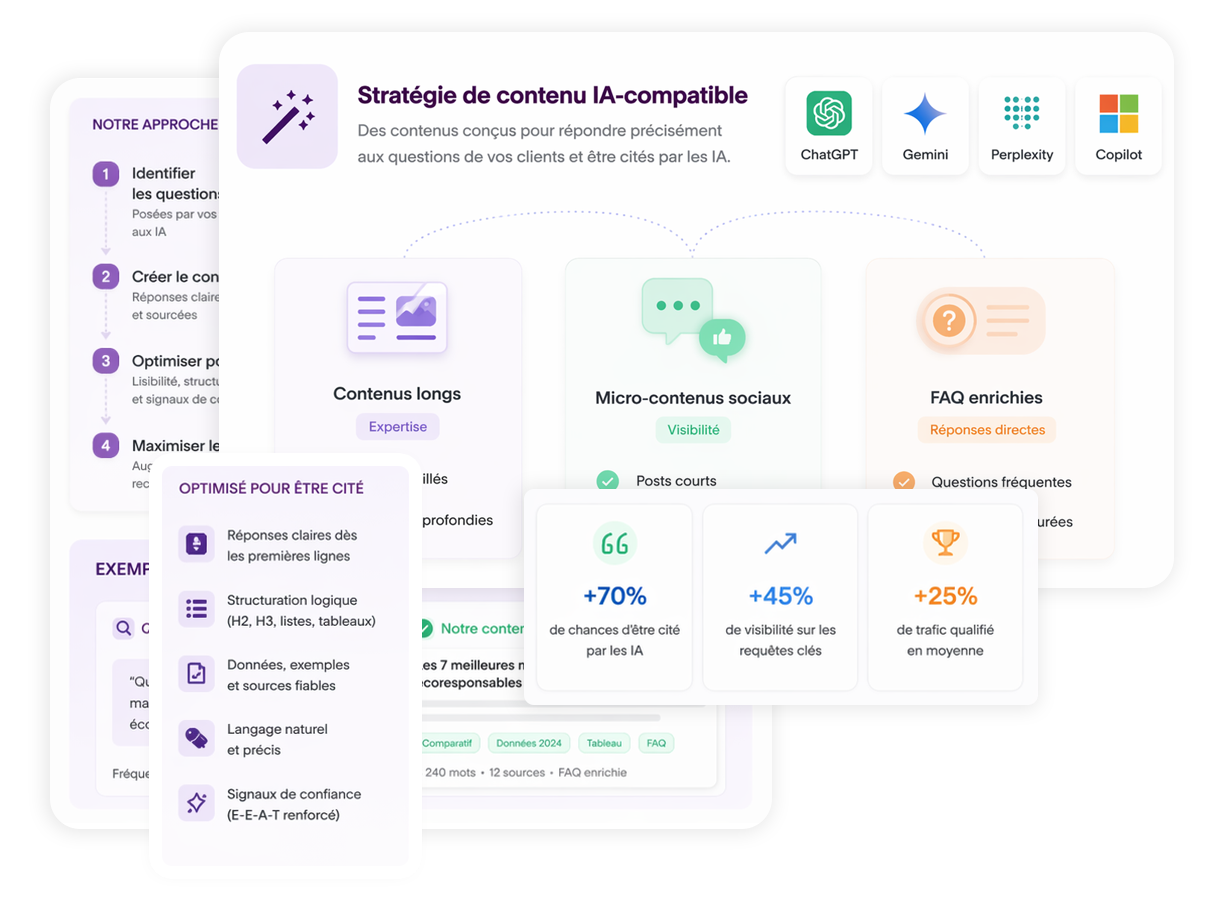
We create and optimise your content to provide precise answers to the questions identified. Whether it’s long-form content, social media snippets or enhanced FAQs, every piece is designed to maximise your chances of being picked up by AI.
AI systems look for clear, factual and well-structured answers. Content that performs well in GEO is content that answers questions directly, provides value without any fluff, and demonstrates genuine expertise. Quality always trumps quantity. A single excellent article can rank for dozens of different AI queries.
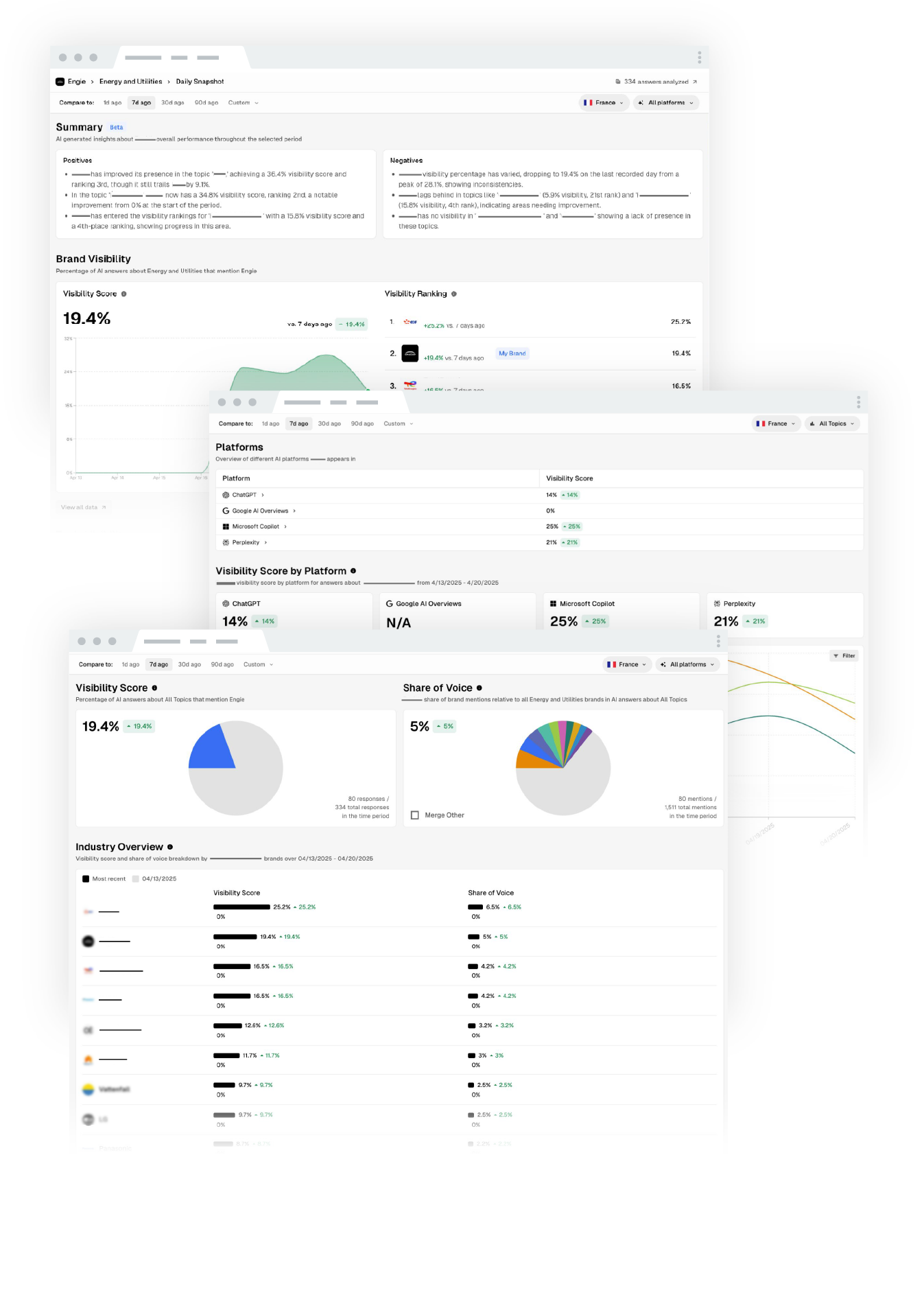
GEO is a marathon, not a sprint. Our tools – Profound, Content Pulse, Nexgen and Daywatch – monitor your visibility 24/7 so we can adjust our strategy in real time and continuously optimise your results
The GEO is constantly evolving: AI models are updated regularly, data sources change, and your competitors are making progress too. Continuous monitoring allows you to quickly identify new opportunities, address drops in visibility, and adjust your strategy. Without monitoring, it’s impossible to know whether your efforts are paying off.
A well-executed GEO strategy doesn’t just boost your visibility in AI systems: it simultaneously improves your SEO and SEA performance, delivering a significantly higher ROI.
GEO & AI
GEO improves your search engine rankings and drives targeted traffic through conversational AI responses (ChatGPT, Perplexity, Gemini).
Growing brand awareness on an emerging channel
A new way to attract qualified traffic
Additional revenue generated without cannibalisation
GEO & SEO
GEO content enriches your website’s semantic framework with high-quality, structured content that also boosts your traditional SEO.
High-quality content optimised for AI crawlers and Google
An enriched semantic cocoon that enhances overall authority
Accelerated and sustainable organic SEO growth
GEO & SEA
Google’s paid features are evolving, with increasingly broad and automated targeting. For these campaigns to be effective, they require specific, well-targeted content.
High-quality GEO content = better Quality Score and relevance
Optimised automated targeting thanks to structured and accurate content
Improved campaign ROI with content optimised for algorithms
GEO isn’t just a one-off optimisation exercise: it’s a cross-channel strategy that boosts your ROI by simultaneously improving your performance across AI, SEO and SEA.
Request an auditINTEGRATED SHOPPING ASSISTANT
E-commerce: Aim to become THE recommended product

ChatGPT, Gemini and Perplexity now feature advanced shopping assistant capabilities. When a user searches for a product, the AI displays enhanced recommendations. Appearing in this selection can generate qualified traffic without any advertising costs.
Strategic Analysis & Benchmarking
B2B: Position Your Solution as the Industry Standard

A majority of B2B decision-makers now use AI to search for solutions. Perplexity, ChatGPT and Gemini generate comprehensive industry analyses, comparisons and strategic recommendations. Being cited in these responses can boost your credibility and feed your pipeline of qualified leads.
Employer Branding & Recruitment
HR: Strengthen Your Employer Brand

Candidates and journalists are increasingly using AI to research companies: corporate culture, employee reviews, benefits and career opportunities. A GEO HR strategy aims to optimise your employer brand so that it is likely to be recommended as an attractive employer within your sector.
Geolocation Search & Recommendations
Local: Maximise Your Location-Based Visibility

AI is becoming the go-to tool for local searches. ChatGPT, Perplexity and Google AI respond to local queries with targeted recommendations, integrated maps and enriched information. Local GEO aims to boost your visibility in these high-intent recommendations.
Ad’s up Consulting has developed and integrated the best tools to monitor your presence in real time on ChatGPT, Gemini, Perplexity and Copilot. Our platforms continuously analyse queries to help you optimise your visibility.
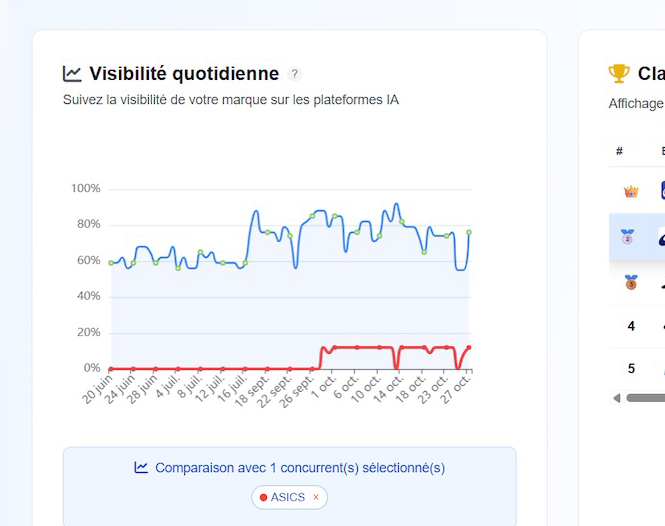
Track your online presence, social media activity and AI-driven conversations. A comprehensive overview of your digital visibility.
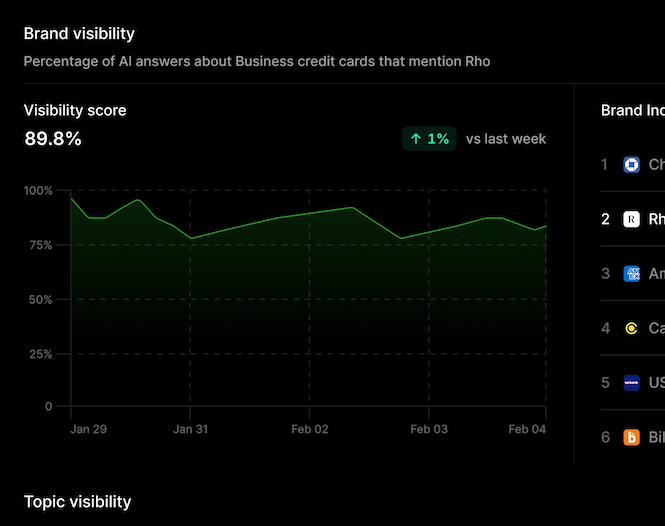
Track your mentions on ChatGPT, Gemini, Perplexity and Copilot in real time. Comprehensive dashboard with detailed metrics.
Generative Engine Optimisation (GEO), also known as GSO, refers to all the techniques used to optimise the visibility of a brand, product or content in responses generated by generative AIs such as ChatGPT, Google SGE or Bing Copilot. Unlike traditional SEO, which seeks to position a web page well, GEO aims to be cited directly in an LLM's response. It's a new form of no-click SEO.
Because generative search engines like SGE or Perplexity reduce the number of clicks: users get the answer directly. If your brand is not mentioned, it becomes invisible. GEO makes it possible to remain present in these new search interfaces. It's a question of brand awareness, reassurance and share of voice in areas where SEO alone is no longer enough.
Oui, et plus que jamais. Le SEO structure le contenu pour les moteurs classiques (Google, Bing), tandis que le GEO prépare ce même contenu à être interprété et repris par les LLM. L’un favorise le classement et la conversion, l’autre garantit votre visibilité dans la réponse synthétique. Ne pas faire de SEO revient à être introuvable. Ne pas faire de GEO revient à ne pas exister dans les réponses IA..
Aujourd’hui, plusieurs moteurs de réponse ou assistants conversationnels reposent sur des modèles de langage (LLM) pour générer des résultats directement synthétisés. Les plus utilisés sont :
LLM assesses:
- Contextual relevance (consistency between question and answer)
- Clarity and logical structure (headings, short paragraphs, understandable formats)
- Authority of the source (E-E-A-T: expertise, experience, authority, reliability)
- Freshness and objectivity of the content
- Content that is unclear, dated or poorly structured will not be included in an IA answer.
Information needs to be broken down into self-contained logical blocks that are easy to extract. Each module should be able to stand alone in a generated response. Use explicit headings (H2, H3), limit long sentences, avoid vague wording and add concrete data. It's an editorial + technical job.
Using tools such as our AI Presence Score, we analyse how your brand is perceived, whether it is cited, in what context, and on which sources. This enables us to measure your real exposure in the responses generated by LLM.
The first signals often appear between 3 and 6 months, depending on the competition, initial SEO maturity and the frequency of LLM updates. GEO is a long-term strategy, but the results are powerful because they are structurally sustainable.
Several agencies are beginning to specialise in optimisation for generative AI. Ad's up Consulting is one of the pioneering GEO agencies in Paris, with an approach that combines advanced SEO, content structuring, AI visibility analysis, and branding for LLMs. Their GEO expertise is aimed at demanding companies wishing to anticipate the profound transformation of search engines.