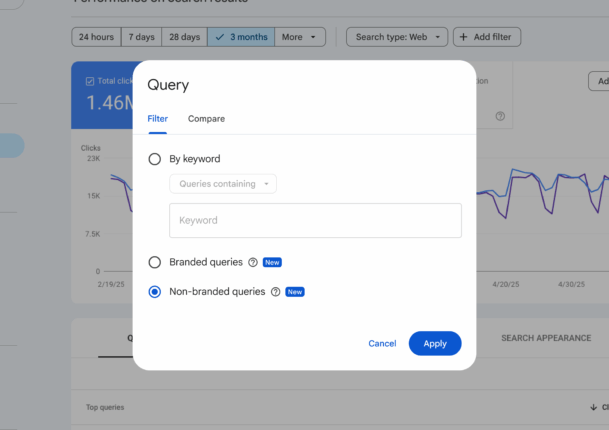
Google is adding a major new feature to Search Console: a filter that automatically distinguishes branded queries from generic queries. The change may seem minor, but it transforms the way SEO is analysed. Brands can finally separate what relates to brand awareness from what relates to organic acquisition. In a context where visibility is fragmented and attribution is becoming complex, this segmentation comes at the right time. It allows for more accurate observation of organic performance and better measurement of a site’s brand awareness.
1. A new feature in Google Search Console
With this filter, Search Console indicates whether clicks and impressions come from a query containing the brand name or from a generic search. Google automatically recognises the company name, its variants, misspellings and flagship products. All other searches are classified as generic.
This distinction works across all types of searches: web results, images, videos, and news. Google has even added a dedicated card in Search Console Insights to view the share of branded and non-branded traffic. The rollout remains gradual and currently only affects the main properties that generate enough queries.
2. What this means for advertisers
This update provides essential clarification. Until now, SEO data mixed brand queries with generic queries. Performance could therefore appear high when it was mainly driven by brand awareness rather than the site’s ability to attract new users.
With this filter, analysis becomes more accurate. Branded traffic reflects the overall impact of marketing actions: media campaigns, offline presence, social networks, or press relations. Unbranded traffic reveals the actual performance of SEO as an acquisition lever. This separation also improves attribution. Teams can understand whether an increase in traffic comes from a TV campaign, social content that has gone viral, or effective SEO optimisation.
The tool also facilitates competitive analysis. By isolating generic queries, brands can more easily identify their strengths, weaknesses, and areas where competitors have the upper hand. This provides a solid starting point for rethinking editorial strategy and strengthening presence on high-potential queries.
3. Opportunities and risks
This new feature opens up real opportunities. It helps to structure a more “discovery”-oriented editorial strategy, based on user intent rather than brand. Teams can identify topics that generate new visitors, measure their potential and track their progress. Segmentation also offers a more reliable way to track brand awareness, an indicator that is often difficult to isolate.
Are there still some limitations? Automatic filtering can be mistaken about ambiguous queries, especially when a product name resembles a generic term. Gradual deployment can also lead to data differences between accounts. Finally, focusing solely on non-brand terms could overlook the importance of brand queries, which remain an excellent indicator of trust and engagement.
The first step is to activate the filter as soon as it appears. It is useful to compare this new data with the exported history in order to establish a baseline. This then allows you to set separate objectives: track the evolution of branded traffic to measure brand awareness, and drive the growth of non-branded traffic to strengthen acquisition.
This segmentation also leads to a review of the content strategy. Pages designed for discovery (guides, comparisons, FAQs or practical articles) become essential for capturing non-brand traffic. Content related to the brand or signature products remains important for reassuring users and supporting conversion.
This new development finally encourages better coordination between SEO, branding, PR and paid campaigns. Understanding the origin of usage patterns makes it possible to orchestrate actions more effectively, avoid duplication and strengthen synergies between the various levers.
Conclusion
With this filter, Google Search Console has reached an important milestone. The clear separation between branded and generic queries allows advertisers to better understand the real value of SEO: acquisition, visibility, awareness, or engagement. In a search ecosystem transformed by AI, where the results page is becoming more conversational and less predictable, this segmentation is becoming a key tool for driving performance.
Our SEO agency supports you in analysing these new signals, structuring your editorial strategy and optimising your organic presence in order to maximise your visibility on queries with the highest strategic value.



 Julien Soumahoro