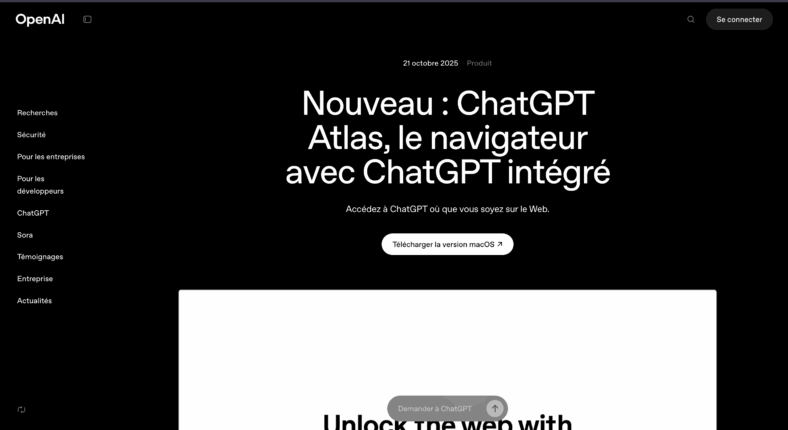
OpenAI has reached a new milestone with the launch of ChatGPT Atlas, its own web browser. This innovation is profoundly transforming the way we access information, interact with online content and, as a result, design SEO and paid media strategies.
ChatGPT Atlas: a browser built around conversational intelligence
ChatGPT Atlas is not just an addition to the existing ecosystem. It is a complete browser, where the AI assistant is integrated into the core of the user experience.
This makes it possible to obtain answers, summaries and actions without leaving the page you are viewing. AI no longer just analyses the web: it understands context, interacts with visible elements and can perform certain tasks on behalf of the user.
This approach puts OpenAI in direct competition with Google. While the search engine ranks results, Atlas merges search, navigation and conversation into a single interface. You no longer type in a query and click on a link: you dialogue with the AI to get an immediate response.
ChatGPT Atlas and the end of clicks: a major shift for SEO
Analyses published by Search Engine Land show that ChatGPT Atlas could change the nature of organic traffic.
The browser is capable of exploring and interpreting web pages, but also of simulating human clicks in order to improve the relevance of its results. However, this ability to “mimic user behaviour” creates a new challenge: how can we distinguish between a click made by a real person and one generated by AI?
Consequently, natural referencing is entering a new era.
Content must be designed not only for internet users, but also to be understood and interpreted by an intelligent browser. In other words, the objective is no longer simply to appear in SERPs, but to make pages readable, usable and actionable for AI, which is becoming the intermediary between the brand and the user.
Implications for advertisers and digital marketing
With ChatGPT Atlas, OpenAI is creating an ecosystem where interaction replaces traditional search.
Brands must therefore anticipate several developments:
- Reassess visibility. Clicks could become a secondary metric. Content must be designed to be interpreted and reproduced by the AI assistant, even without a direct visit to the site.
- Adapt traffic measurement. If AI can navigate autonomously, analytics tools will need to evolve in order to distinguish human traffic from traffic generated by artificial intelligence.
- Rethinking the user journey. The assistant becomes an active player in the funnel. They can assist with searches, compare offers or recommend actions, without leaving the page being viewed.
- Adopt a conversational approach. FAQs, intelligent summaries and structured formats will enable AI to understand and reproduce information more effectively.
A turning point comparable to the arrival of mobile phones or voice search
ChatGPT Atlas not only marks the birth of a browser; it signals the emergence of a new paradigm in information search. Users no longer “search”; they “ask”. AI no longer “displays”; it “acts”. And brands no longer just “attract”; they must “be understood”.
For digital marketing professionals, this change requires a fundamental overhaul of SEO and paid media strategies. The challenge is no longer to occupy the top position on Google, but to be the source that AI will deem reliable, relevant and useful in its interaction with the user.
In short, ChatGPT Atlas heralds a future where the browser becomes a true cognitive co-pilot. For marketers, the challenge is clear: produce content that is readable by humans and designed for artificial intelligence.
To anticipate this shift and ensure your visibility in generative AI search engines and LLMs, our GEO agency can help you integrate these changes into your digital strategy today.
About Ad's up
Charlotte
Chargée de communication



 Charlotte