Since the beginning of the partnership between OpenAI and Microsoft, the idea that ChatGPT would naturally rely on Bing seemed obvious: a logical choice, almost a given.
But one question remains: does ChatGPT rely on Google for its search results?
The context is changing: Google is radically transforming its engine, integrating generative AI directly into its results and promoting its AI Overviews, which now cite their sources. This is enough to reshuffle the cards and reignite speculation.
In recent months, some SEO specialists have even observed that ChatGPT sometimes seems to return results similar to those of Google. Was this a mere coincidence or a genuine connection?
To verify this, we analysed 118,931 queries across a range of topics and compared the results between ChatGPT and Google.
Here is what emerged:
Decoding the method
To understand whether ChatGPT really relies on Google, the approach taken was as follows: observe and compare.
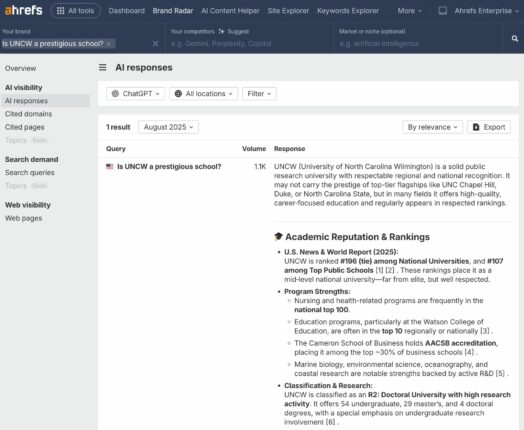
- To understand whether ChatGPT really relies on Google, the first step was to extract the queries generated by the AI, often referred to as "fan-shaped queries", as well as the URLs it returns in response. This data was collected using Ahrefs' brand radars.
- Next, we had to reproduce exactly the same queries directly on Google to see which URLs appeared in its results. This comparison allows us to measure the extent to which ChatGPT's responses reflect Google's rankings.
- Specifically, the analysis focused on the frequency of URLs suggested by ChatGPT appearing in the top 10, top 20 or more broadly in Google results.
And one interesting point already stands out: on average, ChatGPT formulates 1.78 search queries per prompt, and in 75% of cases, it triggers exactly two.
Significant discrepancies between ChatGPT responses and Google rankings
Data analysis reveals significant discrepancies between ChatGPT’s results and those of Google.
On average:
- Only 6.82% of the results suggested by ChatGPT appear in the top 10 Google SERPs.
- 9.85% are in the top 20,
- And 16.61% appear somewhere in Google's SERPs.
In other words, 83.39% of the URLs highlighted by ChatGPT are simply not present in Google search results for the same range of queries. If the AI simply extracted SERPs directly from Google, the overlap would be much higher.
The study, conducted on more than 15,000 prompts, confirms this trend: on average, only 12% of the links cited by ChatGPT, Gemini, and Copilot appear in Google’s top 10 results for the same prompt.
These observations suggest that there is no clear evidence that ChatGPT exclusively, or even primarily, uses Google as its data source. Instead, the model appears to rely on a hybrid approach, combining several feeds: Google and Bing SERPs, its own index, and third-party search APIs. The data is then reprocessed by a proprietary re-ranking algorithm, which explains the uniqueness of the results displayed.
Conclusion:
Ultimately, ChatGPT does not appear to be “secretly optimised by Google”, but rather powered by a combination of sources, orchestrated via a sophisticated reclassification system.
This strategy makes sense, as OpenAI has every interest in not relying on a single search engine and favouring an approach designed for its main objective, which is to deliver accurate, contextualised and immediately actionable answers, rather than a simple web search experience.
This development illustrates a broader transformation: AI is reshaping the way information is produced, distributed and consumed. For brands and advertisers, this means rethinking their visibility and adapting their SEO and Paid Media strategies to these new discovery mechanisms.
Would you like to anticipate these changes and secure your visibility in a rapidly changing ecosystem?
Feel free to contact our SEO agency: our experts will help you optimise your advertising campaigns and boost your digital performance.



 Julien Soumahoro