The launch of ChatGPT in November 2022 was a game changer for search engines. Now, internet users have become accustomed to getting quick, accurate and relatively reliable answers to their questions without having to navigate different websites. In this context, Bing, which ranks as the second largest search engine globally behind Google, recently tested a new tool inspired by certain artificial intelligence chatbots.
Bing is testing a new AI-based product
Do search engines as we know them today have a future in the age of artificial intelligence? For Bing, this is a valid question. While it lags far behind the market leader, Microsoft’s search engine has also lost ground with the advent of AI-based chatbots. More practical and intuitive, these agents have carved out a place for themselves within this ecosystem.
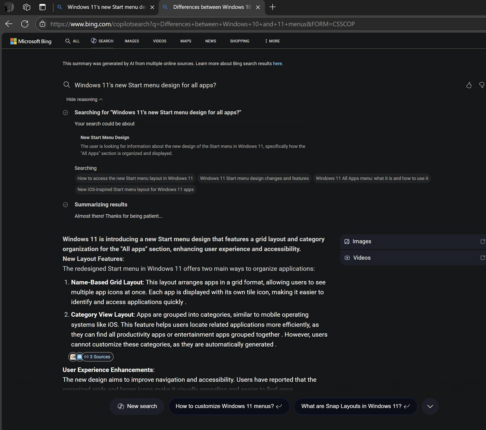
Faced with this threat, Microsoft has attempted to respond. On its search engine, the American company recently began offering a tool called “AI Search”, based on artificial intelligence. The idea is to replace the list of links corresponding to a search with text generated by AI from a number of cited sources. This is a more interactive experience, reminiscent of how certain conversational agents work, such as ChatGPT and Perplexity.
Microsoft is testing a new artificial intelligence-based tool on its Bing search engine. Source: Windows Latest.
A widespread trend
For Bing, the introduction of this new online search feature comes as no surprise. It follows a trend widely initiated by other competitors such as Google, which has already integrated its artificial intelligence tools into its search results (SERP), echoing a now well-known model. Far more than just an innovation, Bing’s new tool is a fitting response to this widespread trend, drawing internet users away from traditional search engines and towards other, more interactive solutions.
ChatGPT’s global reach reflects this new era. According to a Reuters report from last month, OpenAI’s chatbot has surpassed 400 million weekly users. With 15 million active users, Perplexity is also emerging as a major player in this new wave. These are colossal figures for relatively new products, reflecting the new habits and expectations of internet users when searching online.
While Bing’s AI Search tool could make the search engine more up-to-date and therefore more attractive to internet users, Microsoft does not yet seem ready to compete with the undisputed market leader. According to Windows Latest, the AI Search experience “has bugs, is slow and often produces inaccurate results.” There is no doubt that, over the coming weeks, Microsoft will manage to improve its product to make it as practical and relevant as its competitors. In any case, the race for generative AI on search engines is well and truly underway.
Would you like to adapt to new tools based on artificial intelligence? Feel free to consult our SEO agency.
The era of traditional search is giving way to response engines capable of synthesising information in real time. Faced with the rise of generative AI, Microsoft is making a big move by launching the first official tool dedicated to measuring Generative Engine Optimisation. For brands, the challenge is no longer just to be indexed, but [&...
Google has taken a decisive step towards unifying commercial data with the launch of the Universal Commerce Protocol (UCP). This new standard aims to streamline exchanges between platforms using artificial intelligence. For advertisers, the challenge goes beyond mere technology: it is about transforming each piece of product data into a u...
The announcement marks a structural turning point in the digital marketing ecosystem. OpenAI has officially confirmed its intention to integrate ChatGPT Ads, laying the foundations for a model that will compete directly with Google Ads. For advertisers, ChatGPT Ads represent a new strategic acquisition lever, at the crossroads of search, ...
With Google AI Mode Checkout, Google is no longer content with improving search: it is redefining conversion. AI is now capable of comparing offers, selecting a product and finalising a purchase without going through a traditional e-commerce site. This development marks a strategic shift for brands, whose visibility is no longer determine...



 Pierre Blarre