Since 24 August 2026, ChatGPT Ads has been officially available in France, along with 30 other European markets. However, the launch does not yet mean widespread access: the self-service option is not open to all French advertisers. Should we wait? Not really. Now is the time for brands to understand this new advertising landscape and prepare their first tests.
Key points:
ChatGPT Ads is now available in France
. France is one of the 31 European markets covered by the roll-out of advertising in ChatGPT.
Access remains limited for advertisers at present
. Self-service is not yet widely available in France. Access is currently via OpenAI, partner agencies or technology partners.
Targeting is initially based on conversational intent
. At the European launch, adverts are primarily based on the context of the current conversation, rather than on personalised behavioural history.
Initial results should be interpreted with caution
. OpenAI reports a reduction of around 60 per cent in the average cost per purchase over six weeks, but without publishing a methodology detailed enough to serve as a market benchmark.
In summary, ChatGPT Ads opens up a new advertising frontier in France, but the right approach is not to shift budgets immediately. Advertisers would be well advised to start understanding conversational intent now, prepare their measurement strategies and structure their initial tests before the channel is rolled out more widely.
1. ChatGPT Ads France: the launch is official
Since 24 August, ChatGPT Ads has been available in 31 European markets, including France, Germany, Spain and Italy.
The adverts are aimed at users of the Free and Go plans. The Plus, Pro, Business, Enterprise and Edu subscriptions remain ad-free.
The business model is therefore becoming clearer: OpenAI monetises part of its free user base whilst maintaining an ad-free experience for the relevant paid services.
For advertisers, one important distinction remains. The fact that it is available in France does not yet mean it is accessible to everyone in just a few clicks.
The self-service Ads Manager is not yet widely available in France. At this stage, access is primarily via OpenAI, partner agencies or technology partners.
In other words, we are currently in a controlled launch phase, ahead of a wider opening of the channel.
2. How ChatGPT Ads is changing things for advertisers
The main difference compared with traditional advertising platforms lies in the context in which the advert appears.
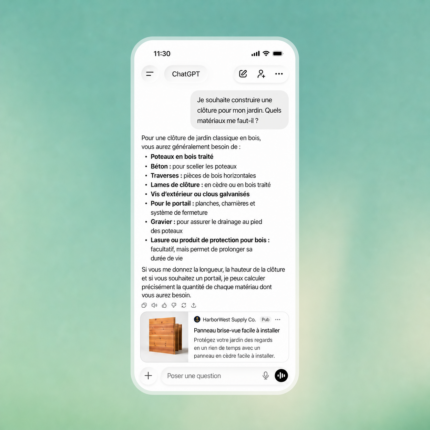
A user does not necessarily enter a few keywords. They may explain their problem, specify their constraints, compare several solutions and then gradually refine their requirements.
The conversation thus provides a particularly rich context for understanding the speaker’s intention.
In Europe, however, OpenAI is taking a cautious approach. At launch, ad selection is based primarily on the content of the current conversation and limited contextual signals. Personalisation based on other information requires the user’s consent.
We are therefore moving closer to targeting based on conversational intent rather than traditional audience-based logic.
This difference can have significant implications for campaigns. The advertising message will need to be relevant to the issue being raised at that moment, rather than simply matching a user profile.
3. Opportunities and risks: it all comes down to trust
ChatGPT’s appeal to advertisers is not solely down to its audience.
It also depends on the role the tool plays in the decision-making process. Users can use it to search for solutions, compare products or services, and gradually refine their criteria.
For a brand, these moments can become new advertising touchpoints.
But OpenAI must uphold a key boundary: advertising must not influence the model’s response.
The company states that the adverts are separate and clearly labelled. Advertisers cannot pay to alter the responses generated by ChatGPT.
This independence is crucial. If the user doubts the impartiality of a recommendation, their trust in the assistant may diminish. And with it, the very value of the advertising inventory.
The same caution applies when it comes to performance.
OpenAI reports a fall of around 60 per cent in the average cost per purchase over six weeks and a reduction of around 20 per cent in CPM. However, the precise scope and methodology behind these results have not been publicly disclosed.
These figures should therefore be regarded as initial indicators provided by the platform, not as market benchmarks.
4. How do you develop your ChatGPT Ads strategy?
The first instinct should not be to immediately transfer a significant proportion of one’s budget.
The first step is to identify the situations in which ChatGPT actually plays a part in its customers’ decision-making process.
Three projects can be launched straight away:
to map out the conversational queries and intentions relating to its products or services;
to identify the instances in which a commercial proposal genuinely adds value;
create messages that address a specific need rather than simply generating a click.
This measure is the second area of focus.
ChatGPT Ads already offers tracking of impressions, clicks and spend, as well as tools for measuring conversions, notably via Pixel and the API.
The initial tests will therefore need to go beyond simply looking at CPC. Acquisition cost, conversion rate, the quality of leads or orders, and the value generated after the click will be more useful in assessing the channel’s true potential.
5. Expert advice: don’t wait for self-service to get ready
For the majority of French advertisers, ChatGPT Ads is not yet a channel to be rolled out on a large scale.
But waiting until it’s fully open before taking an interest in it would be a waste of time.
The top priority today is to understand the conversational intentions of your market. What questions precede a conversion? What criteria are users looking to compare? In which conversations can a brand provide a relevant commercial response?
The initial trials will then need to be conducted within a structured framework, with objectives and indicators defined prior to launch.
The aim is not simply to have a presence on ChatGPT Ads because it is a new channel. It is to determine where this new inventory can deliver incremental performance within the customer journey.
Conclusion: ChatGPT Ads is now available – it’s time to start preparing your tests
The launch of ChatGPT Ads in France marks a new stage in the transformation of search and digital advertising. Brands can now consider buying visibility directly within a conversational environment.
That doesn’t mean, however, that there’s any need to rush.
The priority is to understand the objectives, prepare the campaign and design initial tests that are rigorous enough to determine the place ChatGPT Ads truly deserves within the media mix.
Our ChatGPT Ads agency supports advertisers in preparing, launching and managing their campaigns on ChatGPT, from identifying conversational opportunities to measuring their performance.
FAQ – ChatGPT Ads: Launch in France
Is ChatGPT Ads available in France?
Yes. ChatGPT Ads has been officially available in France since 24 August 2026, as part of an expansion into 31 European markets. However, self-service access is not yet fully available. Advertisers can access the service via OpenAI, partner agencies or technology partners.
Who can see adverts on ChatGPT in France?
Adverts are shown to users of the Free and Go plans. OpenAI keeps its Plus, Pro, Business, Enterprise and Edu plans ad-free. This approach allows the company to monetise part of its free audience without including adverts in the main paid plans concerned.
How does ChatGPT Ads targeting work in France?
At its European launch, ChatGPT Ads relies primarily on the context of the ongoing conversation and certain limited contextual signals. The logic therefore differs from strategies based mainly on behavioural audiences: the advert must correspond to an intention expressed during the conversation.
How do you launch a ChatGPT Ads campaign in France?
The self-service Ads Manager is not yet widely available in France. Access is currently available via OpenAI, partner agencies or technology partners. For advertisers, this phase can be used to prepare the intents to target, messaging, tracking and performance metrics ahead of a wider launch of the platform.
What does LLM referencing involve? It’s about making your brand visible, citable and recommendable by language models – in short, a reference point for AI. More specifically, when users ask ChatGPT, Gemini, Claude or Perplexity directly: ‘What’s the best solution for…?’ “Which company should I choose for…?” or even “Compare the top player...
The role of an SEO specialist has changed significantly over the last two years. Simply optimising relevant keywords and anchor text is no longer enough: the article, or part of the content, must now be selected by a chatbot (ChatGPT, Claude, Gemini, Perplexity, etc.) and included directly in its responses. Ranking on the first page [&hel...
Have you typed your company’s name into ChatGPT recently? If the response made you cringe (or worse, if it didn’t even mention you), it’s time to take GEO seriously. Because by 2026, your customers won’t just ‘Google’ things any more: they’ll ask an AI directly to find them the right answer. If your content isn’t […]...
TikTok is continuing to develop its advertising tools with the integration of Dreamina Seedance 2.5 into Symphony. This new version of the video-generation model developed by ByteDance offers longer videos, greater creative control and improved visual quality. It also comes with new features designed to enhance transparency around content...