Since the launch of Google’s AI Overviews, paid search has entered a new era.
What was previously considered a UX experiment has become a real structural shock for advertisers: a decline in paid traffic, a transformation of the conversion funnel, and new visibility strategies between SEO, SEA, and branded content.
According to a study conducted on more than 21 million SERPs, the share of clicks on sponsored links could decline by 8 to 12 points, representing a relative decrease of 20 to 40% in the most competitive sectors. This is a strong signal: the Search Engine Results Page is no longer just an auction space, it is now an AI-driven ecosystem, shaped by Google’s AI Overviews.
When Google AI Overviews come between the query and the click
AI Overviews now appear above ads and organic results, summarising answers from multiple sources. This prominent position transforms the SERP hierarchy: users get their answers without necessarily clicking.
Result:
- Lower paid visibility on the page
- A decline in CTR on PPC campaigns
- And an urgent need to rethink the Google Ads presence strategy
Advertisers can no longer rely solely on the power of their bids. Now, content quality and semantic relevance are becoming SEA levers in their own right, in a landscape dominated by Google’s AI insights.
AI Overviews available for queries with high business potential
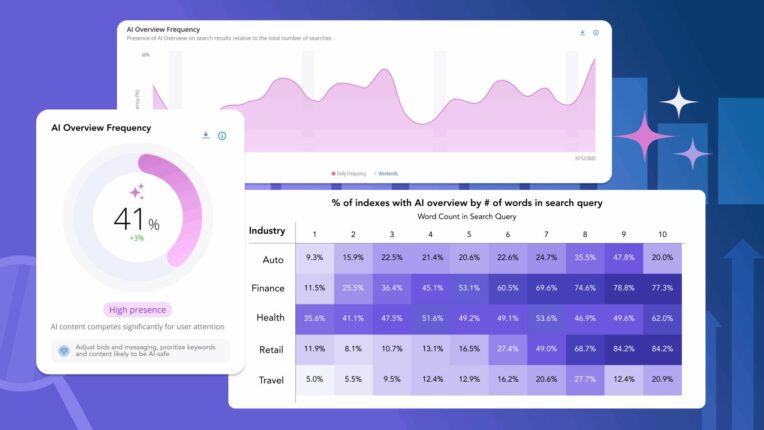
Initially limited to long informational queries (e.g., how to choose a car loan?), Google AI Overviews now appear on short, high-volume keywords at the heart of commercial queries. This means that they enter directly into the conversion funnel, where advertising investments are highest.
The funnel is “compressing”: AI responses are partially replacing adverts for transactional queries (buy health insurance, best mortgage, book hotel in Paris).
Consequence: the user journey is reorganised around a single entry point, the AI response generated by Google, which sometimes already includes sponsored content or partner sources.
Google AI Overviews: highly contrasting sectoral impacts
Adthena’s study reveals that the influence of Google AI Overviews varies greatly across sectors, creating a multi-speed landscape.
The financial sector has seen the most significant growth (+9.9%). Commercial and comparative queries, historically dominated by advertisements, are now overwhelmingly covered by AI-generated responses.
The healthcare sector also has a strong presence (+8.3%). AI Overviews appear frequently, even for short queries. However, Google seems to limit its scope to complex medical queries for reasons of reliability.
In the travel sector, growth is more gradual (+5.8%), but already visible: AI Overviews are emerging on planning queries (best time to visit Rome, sunny destinations in November).
Retail trade shows moderate growth (+2%), concentrated on long searches related to products, while the automotive sector is experiencing similar growth (+2%), marked by disruption in model comparison queries.
In short, the more a sector combines search volume, decision-making complexity and high conversion value, the more it is exposed to the rise of Google’s AI Overviews.
The new winners of visibility on AI Overviews
Brands that perform well in Google’s AI Overviews have one thing in common: they produce high value-added content. Comparisons, guides, expert analyses, and detailed FAQs are all formats that Google uses to fuel its generative responses.
Comparators, aggregators and editorial brands thus gain an advantage over pure players focused on paid advertising.
Players capable of feeding Google’s AI with quality content see their organic (and indirectly paid) visibility increase.
AI Overviews and Search: towards a new balance between SEA and SEO
The boundaries between SEO, SEA and branded content are blurring. Advertisers must now think about search as a whole, integrating:
- content production as a lever for advertising performance,
- AI data as a new signal of intent,
- and the complementarity between Paid and Organic as a driver of synergy.
SEA management is therefore becoming hybrid: it is no longer just a question of controlling bids, but of understanding how Google’s AI Overviews filter and reformulate information.
From lost clicks to creating opportunities with AI Overviews
The arrival of Google AI Overviews is not just a threat: it is also an opportunity for strategic repositioning. Advertisers can:
- strengthen their presence on queries not covered by AI previews,
- adapt their advertising messages to new user intentions,
- and utilise data from analytical tools to detect emerging queries.
Ultimately, SERP is becoming a testing ground for AI, where Paid, Organic and Generative overlap.
Google’s AI Overviews are no longer a curiosity: they are reshaping search as we know it. In a context where visibility is fragmented and clicks are becoming scarce, advertisers must learn to steer differently:
- by merging their SEO and SEA strategies,
- by investing in structured and reliable content,
- and by measuring performance beyond the click.
The future of search is already being shaped by AI. Would you like to understand how these developments impact your performance, rethink your SEA strategy in the age of AI, and identify new growth drivers?
Our Google Ads agency supports you in implementing integrated and sustainable search strategies capable of transforming your arrival.



 Julien Soumahoro