Google IO 2025 announcements: Gemini redefines brand engagement in the age of generative AI
Learn more about our expertise Search & Shopping22/05/2025 3 min. reading Maud
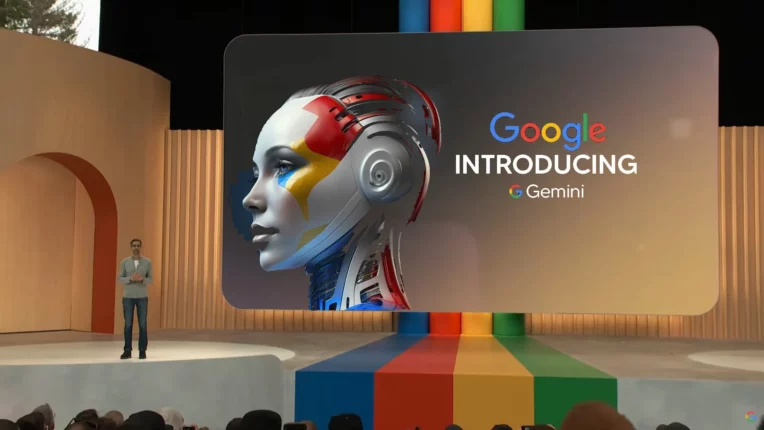
The annual Google I/O 2025 conference was held on 21 May and clearly demonstrated a strategic desire to make artificial intelligence not just a simple optimisation tool, but a central pillar of its ecosystem. For brands and digital marketing professionals, the Google IO 2025 announcements mark a turning point. Google is no longer content with simply structuring access to information: it wants to orchestrate interaction, creation and automation via Gemini, its next-generation AI.
Gemini 2.5: the technological building block that will transform digital marketing
Google IO announcements highlighted the arrival of Gemini 2.5, a multimodal artificial intelligence that is faster, more powerful and natively integrated into all Google products. For brands, this means that AI tools will no longer be on the periphery of campaigns but at the heart of content strategy, media activation and customer relations.
Gemini 2.5 Pro introduces Deep Think mode, which can analyse a marketing brief, suggest coherent creative scenarios and even anticipate performance across different channels. For brands seeking to optimise their ROI, this version acts as a strategic co-pilot. At the same time, the lighter Gemini Flash facilitates the rapid creation of high-speed content, perfect for highlights or A/B testing on social media.
The launch of Gemini Live will open up a whole new dimension in customer interfaces. Available soon on Android and iOS, this AI assistant reacts in real time to the user’s environment, allowing brands to imagine ultra-personalised service experiences based on voice, image and context. This makes it possible to design activation campaigns based on visual recognition (products, logos, locations), interacting directly with the phone’s AI.
Another notable announcement at Google’s IO conference was Project Astra. This project paves the way for contextual AI that perceives the world through a camera and interacts naturally via voice. For retailers and experiential brands, Astra could revolutionise phygital in-store and event experiences by assisting customers with their choices or orchestrating immersive product demonstrations.
Generative content: how Gemini is driving advertising creation
In line with Google’s IO announcements, generative creative tools are gaining momentum. With Imagen 4 for image generation and, above all, Veo 3 for video, Google is entering the virtual studio arena. Brands can now imagine video adverts created from a text brief, with HD rendering, soundtrack and consistent visual narration. This is a game changer for advertisers on a limited budget or for accelerating large-scale creative production.
The new Google Flow feature also assists in the design of customised videos, animations and stories. For marketing teams seeking autonomy, these tools accelerate production and promote creative consistency across multiple platforms. This strengthens brands’ ability to produce high-value native content without relying exclusively on external studios.
Search, browsing, retail media: Google at the service of conversion
Google’s IO announcements show a major evolution in online search. Thanks to Gemini, SERP is becoming conversational and predictive. The search engine now offers summaries of results, visual suggestions and even integrated comparison tools. For brands, this implies a profound transformation of traditional SEO. Optimisation is no longer just about pages, but also about the ability of content to feed into AI understanding.
Gemini’s ability to interact with websites also heralds the arrival of conversational agents capable of making purchases, booking travel or choosing products without leaving the Google environment. For e-commerce brands, this is a revolution comparable to the arrival of voice search: being integrated into the AI flow is becoming a strategic priority.
New business models: AI as a Service for all advertisers
One of the most business-oriented announcements at Google I/O concerns the new pricing structure. With Gemini Pro available for €21.99/month in France and the arrival of Gemini Ultra at $250/month, Google is opening up its AI capabilities to all types of advertisers. Brands can now access tools for automatic writing, performance analysis, video creation, media plan generation and creative briefs.
This democratisation of high-end AI will reshuffle the deck in the digital marketing sector. Whereas yesterday only large corporations could industrialise the use of artificial intelligence, tomorrow even SMEs will be able to implement workflows optimised by Gemini. The era of augmented marketing begins here, and it is native to Google.
Conclusion: Google’s IO 2025 announcements impose a new marketing grammar
Following the IO conference, one thing is clear: the very model of the digital ecosystem is changing. Gemini does not replace existing tools, it encapsulates them to better control them. For brands, the challenge is twofold: understanding this new AI intermediation environment, but also quickly integrating these innovations into their content, data and customer experience strategy. Google’s IO announcements are not just technical developments; they herald a profound shift in marketing practices.
The rollout of Mix Experiments in beta marks a decisive step forward in the automation of media buying on Google Ads. This cross-campaign testing feature finally allows advertisers to break down technical silos and allocate their budgets based on real incrementality, rather than sector-specific intuition. Towards the end of silos: data-dr...
With Google Ads audiences of 100 users, Google is redefining the rules of advertising targeting. Until now, activating audiences required high volumes, which were often incompatible with the realities of SMEs, B2B players, or niche markets. By lowering the minimum threshold to 100 users, Google Ads is broadening access to remarketing and ...
Google recently reposted several support pages dedicated to Website Optimizer, a new tool that may soon appear in the “Reports” tab of Google Ads, connected to GA4. The name evokes the historic tool launched in 2008, which became Google Optimize before its disappearance in 2023, but initial indications suggest a completely red...
The suspension of a Google Ads account is one of the scenarios most feared by advertisers. A simple alert message can halt campaigns, impact revenue and keep teams busy for days trying to identify a cause that often turns out to be unclear. Over the past few months, the platform has rolled out several major […]...



 Maud
Maud