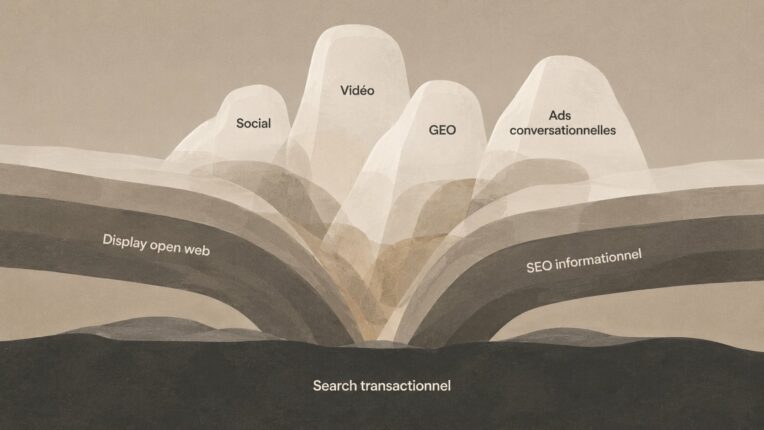
AI Overviews, GEO, Social, SEA, Display: how to reallocate your media mix in the face of declining organic clicks and new AI interfaces.
When an AI Overview appears in Google, organic outbound clicks fall by an average of 39.8 per cent, according to an experiment published in 2026. At the same time, a panel of premium US and UK publishers recorded up to a 41 per cent reduction in ad requests on their pages.
These studies do not measure the same phenomenon, but they describe a common trend: users are obtaining more information without visiting the websites that produce it. The GEO strategy must now take this new flow of attention into account when balancing SEO, display advertising, social media and paid search.
Key takeaways:
GEO now extends beyond the scope of SEO alone
👉 Visibility in generative search results depends not only on the brand’s website, but also on the media outlets, comparison sites, social media platforms, content creators and communities used as sources by search engines.
The media mix must follow the shift in attention
👉 The contraction of certain display ad inventories on the open web calls for a greater focus on premium environments, YouTube, social media, content creators and new AI-powered advertising interfaces.
SEA and transactional SEO remain priorities for conversion
👉 Searches close to the point of purchase continue to generate more clicks. Paid search, Shopping, transactional content and first-party data therefore retain a central role.
Measurement must link generative visibility to business results
👉 Mentions and citations in AI-powered search engines must be linked to brand searches, assisted conversions and incrementality tests, rather than being assessed solely on a last-click basis.
In summary, AI Overviews are transforming search journeys by reducing organic clicks on informational queries and redistributing attention across generative search engines, social media and other media. To remain visible, brands must move beyond an SEO-centric approach and build a GEO strategy that coordinates content, paid media, social media and data. The challenge is no longer simply to generate clicks, but to be present, mentioned and performing well at every stage of the user journey.
AI previews reduce the number of clicks on informational queries
The study conducted by Saharsh Agarwal and Ananya Sen measures the effect of AI Overviews on search behaviour. When an AI-generated overview appears, organic clicks to external sites fall by 39.8 per cent and searches without clicks increase by 34.5 per cent. Paid clicks did not show a significant decline in this experiment.
Search intent plays a key role. An AI Overview appears in 53 per cent of the informational queries studied, compared with 6 per cent of transactional queries. Google therefore tends to provide direct answers to questions at the early stages of the search journey, whilst searches closer to the point of purchase continue to generate clicks.
A brand’s visibility can no longer be measured solely on the basis of its search rankings and organic traffic. A generative response may highlight a company, mention its products or cite one of its sources without generating an immediate session on its website.
This development broadens the scope of the GEO.
GEO goes beyond the scope of SEO
Generative Engine Optimisation, or GEO, aims to strengthen a brand’s presence in the responses generated by ChatGPT, Gemini, Perplexity, AI Overviews and other generative engines.
The brand’s website remains an important source, but the assistants also draw on media outlets, comparison sites, YouTube, Reddit and content published by creators. The sources cited vary depending on the search engine, topic and sector. A one-size-fits-all strategy would therefore replicate the limitations of older SEO approaches based solely on keyword volume.
Teams must work in two complementary areas:
The website, with a user-friendly technical framework, accurate content and verifiable information.
Third-party sources that search engines consult to verify information or compare offers.
GEO thus brings together SEO, social media, press relations and brand strategy. This convergence also has an impact on budgets. When part of the discovery process takes place within a generated response or a social media feed, investment in the top of the funnel must keep pace with changing user behaviour.
Display and Programmatic: a scarcer inventory on the open web
In the second quarter of 2026, Ozone analysed approximately 20 billion ad impressions from a panel of premium publishers in the United States and the United Kingdom. The volume of ad requests fell by between 32 and 37 per cent in the US market and by between 39 and 41 per cent in the UK market compared with the previous year.
The decline does not apply to the entire global programmatic market. It relates to a specific sample across two regions. The data does not cover France, although the roll-out of AI Overviews means this clickless search mechanism is relevant to French advertisers.
Panel expenditure fell by 30.6 per cent in the first half of 2026. The situation varies significantly between the two markets: spending fell by 14.3 per cent in the UK and by 44 per cent in the US. In June, eCPMs rose by 30 per cent in the UK and by 7 per cent in the US.
Part of this decline is due to the fall in page views. Some publishers are also deliberately reducing low-quality ad placements or queries in order to make better use of the remaining audience attention. The rise in CPMs does not, therefore, in itself prove a decline in return on investment.
For advertisers, making the right choice means reassessing the open web against more stringent criteria:
Audience loyalty and engagement.
The contextual quality of environments.
The proprietary data available.
The actual attention generated by the campaigns.
Publishers with registered subscribers, apps, newsletters or active communities can continue to play a significant role in the media mix. Ad inventory that is difficult to differentiate will be hit harder by the market downturn.
Informational SEO: refocusing content on usefulness and citations
AI Overviews are taking a share of the clicks that used to be generated by simple educational content. A page that rephrases a definition already available in dozens of sources offers little value to the reader and provides little distinctive material for generative models.
SEO teams must therefore strengthen content related to commercial and transactional intent: categories, products, services, useful comparisons, evidence and responses to objections. These pages are closely linked to conversion and address needs that Google finds harder to summarise.
Informational content still plays a role, provided it offers identifiable information. A proprietary study, a tried-and-tested method, an opinion from a named expert or up-to-date data give search engines a reason to cite the source. A clear structure then makes it easier to extract the information.
The same logic applies to backlinking. The sheer volume of links is becoming less important compared to editorial relevance, subject-matter authority and a source’s ability to appear in search results. A link published on a recognised media outlet within the sector can boost search engine rankings, brand awareness and organic visibility.
The scope of SEO is broadening: to attract qualified traffic, strengthen the brand’s authority and increase its chances of being cited as a source.
The SEA maintains a strong position in terms of transaction intentions
Transactional queries remain less affected by AI Overviews in Agarwal and Sen’s study. Sponsored clicks also hold up better than organic clicks when the overview appears.
Google has a financial interest in preserving these moments of high intent. Advertisers must, however, continue to monitor their brand’s coverage, the search queries actually captured and the value generated after the click.
First-party data takes on greater importance here. It enables teams to focus their bidding on sales, margins, qualified leads or high-value customers, rather than simply optimising conversion volume. Teams can combine Google’s signals with their own sales data and business rules.
AI Max for Search extends this approach to more complex queries through broad matching, keyword-free matching and component adaptation. Paid Search thus retains its role in capturing demand, whilst gradually expanding its scope.
YouTube and social media are becoming search platforms
The shift in focus towards social media platforms had begun before the advent of generative AI. Users are already turning to these platforms for reviews, demonstrations, comparisons and user experiences.
Search engines are now incorporating this content to a greater extent. Google is testing a ‘Social Channel Insights’ report in Search Console, which focuses on the performance of YouTube, Instagram and TikTok accounts linked to a website. The feature is still in the experimental stage and Google itself identifies the relevant accounts, but its existence confirms the gradual integration of social content into search analytics.
YouTube holds a special place. An analysis by Ahrefs, reported by Search Engine Journal, attributes 5.6 per cent of the citations observed in the AI Overviews to it, making it the most cited domain in the sample. In Similarweb’s data on ChatGPT, Reddit also features among the main sources.
Organic visibility and paid media have different effects. A useful video or a Reddit thread can spark a generative response. A YouTube Ads or Social Ads campaign buys reach amongst an audience. Both approaches address the same shift in attention.
A coherent strategy may combine:
Native content designed for the specific purposes of each platform.
Partnerships with designers or established communities.
A cost-effective way of promoting content that has already proven its relevance.
Monitoring the brand’s presence in search results and generative responses.
The operational boundary between SEO and social media is becoming less clear-cut. Teams need to share their topics, research data and insights on the formats that drive engagement.
Advertising is making its way into AI-powered interfaces
OpenAI is gradually rolling out advertising on ChatGPT. Its advertising platform already supports CPM and CPC bidding, as well as conversion tracking via pixel or API. As of 29 July 2026, direct access remains limited to seven countries: Australia, Canada, Japan, South Korea, New Zealand, the United Kingdom and the United States. France is not yet included on this list.
Google is taking a different approach with AI Max for Shopping. This suite of features, currently in beta, enhances existing Shopping campaigns. It can adapt product titles, extend destination URLs and serve text adverts generated from the Merchant Centre feed. These adverts can also appear on AI-powered surfaces, such as AI Overviews and AI Mode.
AI Max for Shopping is specifically designed to capture conversational queries from the middle of the purchase journey that traditional Shopping may miss. The documentation and product announcement are available in France, but its activation may still vary depending on the account during the beta phase.
ChatGPT Ads and AI Max for Shopping address the same shift in behaviour without offering the same way of shopping. The former displays a product catalogue within a conversational assistant. The latter extends Google Ads to new search experiences.
These channels may receive a portion of the advertising budgets that were previously concentrated on display advertising. However, this reallocation must be carried out through a phased testing process, as volumes, formats and measurement methods still vary across platforms.
How to rebalance the media mix
The tunnel level helps to structure the initial trade-offs.
Course difficulty
Pressure observed
Priorities to be considered
Brand awareness
A reduction in certain open web inventories and a shift in focus
Premium display, YouTube, social ads, creators and communities
Consideration
Answers without clicking and searches carried out within the assistants
GEO content, organic social media, press relations, ChatGPT Ads and AI Max for Shopping
Conversion
Low prevalence of AI Overviews in transactional queries
SEA, transactional SEO, Shopping and first-party data activation
This framework does not justify a blanket reduction in display or SEO. The correct allocation depends on the sector, profit margin, decision-making cycle and data maturity. A B2B advertiser, a travel brand and an e-commerce site will not encounter the same queries or the same sources in generative responses.
The strategy must begin with an analysis of actual pathways:
Identify the queries and topics covered by AI Overviews or assistants.
Identify the domains, platforms and formats they mention.
Compare this presence with current investments and observed performance.
Test budget transfers on a limited scale before rolling them out more widely.
The measure must link generative visibility with business results
Analytics tools often attribute a conversion to the last visible touchpoint. A user might discover a brand on ChatGPT, watch a YouTube video, and then return via a brand search. Search will then receive the credit, even though several interactions led up to the decision.
The GEO initiative aims to bring together several categories of indicators:
The share of visibility, mentions and citations in generative search engines.
Trends in brand searches and direct traffic.
Assisted conversions and session quality.
The results of the incrementality tests.
Geographic testing allows areas affected by a change to the marketing mix to be compared with control areas. Marketing mix modelling helps to estimate the contribution of different channels over a longer period. These methods do not replace the operational monitoring of campaigns, but they reduce reliance on last-click attribution.
Marginal return provides the right benchmark: how much additional value does the next euro invested in a given channel generate? This question helps to avoid retaining an investment solely because its past performance appears strong, or shifting investments too quickly towards a new asset class.
Expert advice: developing a GEO strategy across the media mix
AI Overviews reduce the proportion of user journeys that start with an organic click, but demand continues to flow between search engines, social media, traditional media and voice assistants. Brands need to organise their presence across all these channels.
GEO therefore provides a framework for coordination. SEO focuses on the quality and accessibility of sources. Social Media develops content tailored to the platforms. Paid Media secures user intent and tests new ad formats. The Data teams link these exposures to commercial results.
Our agency, GEO, supports you in adapting your search, SEA and content strategies for the era of AI interfaces, to identify new drivers of performance and build sustainable solutions in response to changes in search.
GEO (Generative Engine Optimisation) involves optimising visibility in generative search engines and large language models (LLMs). It extends SEO by incorporating the citation logic specific to AI interfaces.
Do AI Overviews affect all queries?
No. They mainly affect informational queries: 53 per cent of these queries trigger an AI Overview. Transactional queries remain largely unaffected, with only 6 per cent of such queries affected.
Should we abandon display advertising?
No, but we need to rebalance it. The 40 per cent decline in ad inventory on the open web is reducing ROI. Focus your budget on high-engagement publishers and redeploy a portion towards social media and GEO.
How can we measure the impact of a budget reallocation?
Through incrementality tests: Geolift, Media Mix Modelling (MMM) or geographical experiments. These methods isolate the actual contribution of each channel.
What does LLM referencing involve? It’s about making your brand visible, citable and recommendable by language models – in short, a reference point for AI. More specifically, when users ask ChatGPT, Gemini, Claude or Perplexity directly: ‘What’s the best solution for…?’ “Which company should I choose for…?” or even “Compare the top player...
Since 24 August 2026, ChatGPT Ads has been officially available in France, along with 30 other European markets. However, the launch does not yet mean widespread access: the self-service option is not open to all French advertisers. Should we wait? Not really. Now is the time for brands to understand this new advertising landscape and [&h...
The role of an SEO specialist has changed significantly over the last two years. Simply optimising relevant keywords and anchor text is no longer enough: the article, or part of the content, must now be selected by a chatbot (ChatGPT, Claude, Gemini, Perplexity, etc.) and included directly in its responses. Ranking on the first page [&hel...
Have you typed your company’s name into ChatGPT recently? If the response made you cringe (or worse, if it didn’t even mention you), it’s time to take GEO seriously. Because by 2026, your customers won’t just ‘Google’ things any more: they’ll ask an AI directly to find them the right answer. If your content isn’t […]...