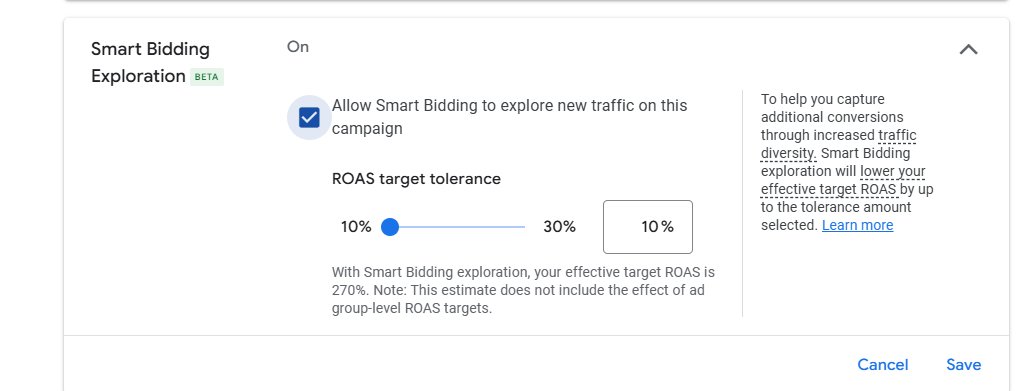
Google continues to evolve its automation solutions by integrating Smart Bidding Exploration into Performance Max. This feature, announced at Google Marketing Live, introduces more flexible ROAS targets and allows advertisers to capture more conversions. But as is often the case with AI applied to digital marketing, the challenge remains a delicate balance. It is necessary to reconcile growth in results with control over return on investment.
A strategic shift for advertisers
Google is unveiling Smart Bidding Exploration today because many marketers have encountered a limitation: overly strict ROAS targets that restrict the reach of their campaigns. In other words, the quest for maximum performance sometimes resulted in lost opportunities.
Thanks to the exploration of smart bidding, Performance Max is no longer limited to direct purchase intentions. The platform now also incorporates more exploratory queries. For example, an internet user searching for “how to buy a house” can now be targeted. Previously, only more specific queries such as “mortgage rates” were prioritised. This opening up of the platform redefines the logic of automated bidding, as it places the discovery of new intentions at the centre of the strategy.
Key contributions of Smart Bidding Exploration
When Google unveiled Smart Bidding Exploration, the objective was clear: to give advertisers more leverage to break free from the constraints of overly rigid management and seize new growth opportunities. Three major advances stand out.
Until now, strict ROAS targets have limited Performance Max campaigns. They prevented advertisers from exploiting broader queries, even though these generate value. Now, advertisers have greater flexibility to adjust the balance between volume and profitability. In practical terms, this means that a brand can accept conversions at a slightly higher cost if it means expanding its customer base and increasing long-term value. This flexibility transforms the way bidding strategies are designed, incorporating a more dynamic view of ROI.
More flexibility in ROAS targets
Google unveils Smart Bidding Exploration as a continuation of AI Max. The solution uses more accurate algorithms to analyse signals. While traditional smart bidding was mainly aimed at immediate conversion, this new feature paves the way for earlier and sometimes less obvious intentions. For example, a user who types in “how to buy a house” can now be targeted well before searching for “mortgage rates”. Thanks to this anticipation, brands can nurture the top of the funnel, influence decisions upstream and consolidate their presence on complex customer journeys.
Beyond rhetoric, Google provides initial figures to legitimise this development. Initial tests show an 18% increase in unique query categories that generate conversions. They also reveal a 19% increase in the total number of conversions. These results indicate interesting potential for advertisers willing to experiment. However, the real challenge is to verify whether these incremental conversions remain profitable in the long term.
More sophisticated AI and measurable results
In short, Google is unveiling Smart Bidding Exploration as a tool at a crossroads. On the one hand, it opens up new opportunities; on the other, it requires cost control. These figures demonstrate Google’s desire to enhance the effectiveness of Performance Max campaigns, while expanding the range of possibilities for advertisers.
These figures illustrate Google’s desire to enhance the effectiveness of Performance Max campaigns, while opening up new possibilities for advertisers.
What the experts think
Jonni Lomax, director of Lomax PPC, reacted as soon as this new feature appeared: “If we’re optimistic, it means that when competition is strong, data quality is preserved. If we’re pessimistic, it will reduce the overall ROAS.” This duality perfectly sums up the dilemma: gaining volume, but accepting more flexible budgetary discipline.
In summary, Google is unveiling Smart Bidding Exploration as a strategic lever to enhance Performance Max campaigns. However, advertisers will need to test and adjust with caution. They will also need to verify whether the incremental conversions obtained actually compensate for the relaxation of the ROAS framework.
Ultimately, this development illustrates the new direction of AI-driven digital marketing: greater flexibility, greater volume, but also a greater need for strategic oversight.
Would you like to make your e-commerce data more reliable and activate these new levers? Feel free to contact our Google Ads agency to assist you with integrating Google tools.



 Julien Soumahoro