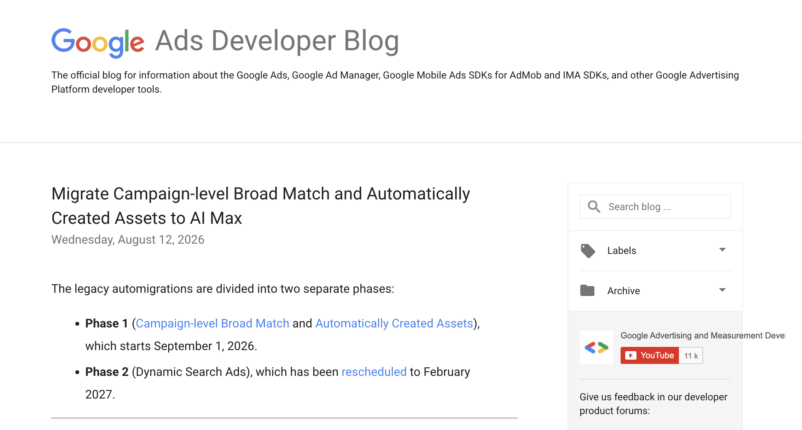
The Google Ads AI Max migration will reach a significant milestone from September 2026. Google will begin automatically converting certain Search campaigns that use automatically generated ad groups or broad match at campaign level. DSA campaigns, meanwhile, have until February 2027. For advertisers, the immediate priority is therefore to identify the campaigns affected and review their settings before the migration begins.
Key points to remember:
The first migration will begin in September 2026 . Search campaigns using automatically generated ad units or broad match at campaign level will be gradually migrated to AI Max.
DSAs will not yet switch over automatically
; Google has postponed their automatic migration until February 2027, allowing several extra months to test and prepare for the transition.
The settings enabled after migration depend on the current configuration
. In particular, a campaign using automatically generated components will switch to AI Max with search term matching and text adaptation enabled.
An audit must be carried out before migration
. Advertisers must identify the affected campaigns, check their settings and establish a performance baseline before the change.
In summary, September 2026 does not mark the immediate end of DSAs. It does, however, represent an operational deadline for Search accounts already using certain automated features in Google Ads.
The timetable is therefore more nuanced than a blanket migration from Search to AI Max. There are now two deadlines: September 2026 for certain legacy features and February 2027 for the automatic migration of DSAs.
Google Ads AI Max migration: what’s really changing in September 2026
From 1 September, Google will begin automatically migrating eligible Search campaigns that use Automatically Created Assets (ACA) – now referred to as text adaptation – or broad match at campaign level. The roll-out is expected to continue gradually throughout the month.
Behaviour following migration will depend on the initial configuration.
For a campaign using exact match, Google plans to enable AI Max with search term matching and text adaptation. For a campaign using broad match, search term matching will be enabled.
The timetable for DSAs is different. Their automatic migration, originally scheduled for September, has been postponed to February 2027 following feedback from advertisers. Google is therefore giving them additional time to test AI Max and organise their transition.
This distinction is crucial: waiting until 2027 on the pretext of continuing to use DSA may lead us to overlook the fact that other campaigns on the same account are likely to switch over as early as September.
What this means for advertisers: auditing is now a priority
AI Max is not simply a rebranding. Google has incorporated into this system a number of capabilities that influence query coverage, content creation and, where applicable, the selection of landing pages.
The first audit must therefore focus on whether the campaigns are eligible for the September migration.
In particular, the following must be identified:
campaigns using text adaptation or its previous ACA settings;
campaigns with ‘broad match’ enabled at campaign level;
the DSAs, to be separated into a second migration project;
any scripts, external tools or API integrations that affect these settings.
This last point is particularly important for complex accounts. Google recommends that API users identify any integrations that are still attempting to create or modify the relevant legacy settings.
You then need to establish a baseline prior to migration: queries generated, conversions, CPA or ROAS, conversion value and spend allocation. The aim is not to attribute any future changes to AI Max, but to have a basis for comparing performance before and after the change.
Opportunities and risks: greater automation requires greater control
Google presents AI Max as a way of expanding search coverage by drawing on a wider range of signals than those historically used by search engine algorithms. In particular, the system can utilise keywords, adverts, website content and intent signals.
Google also states that, according to its internal data on non-retail advertisers, using the full range of AI Max features generates, on average, 7 per cent more conversions or conversion value at a similar CPA/ROAS, compared with using search term matching alone. This result is based on Google’s data and should therefore not be interpreted as a guaranteed performance for every account.
The opportunity lies in the ability to capture searches that were not covered by the account’s historical structure.
The risk is two-sided: broader coverage must remain consistent with the advertiser’s commercial objectives.
Teams must therefore look beyond the volume of conversions. The quality of the queries captured, the value generated and the consistency of the creative content are becoming key indicators for assessing the migration.
How can you adapt your strategy before September?
The priority is not to enable AI Max everywhere before the deadline. It is to understand exactly what will change in each campaign. The audit can be structured around four key actions.
1. Identify the campaigns concerned. Separate the campaigns that will be migrated from September from the DSAs affected by the February 2027 deadline.
2. Check the current settings. Text adaptation and broad match at campaign level must be identified. This overview enables you to anticipate which AI Max features will be activated during the migration.
3. Review search queries and ad creation. Identify the search terms that actually generate value and the messages that need to be kept under control. Text adaptation can generate new headlines and descriptions based on the context of the advert, the domain, the landing pages and the keywords.
4. Test before rolling out widely. Google recommends using its voluntary migration tools and trials to gauge the impact of AI Max before the automatic upgrade.
This testing phase is particularly useful for distinguishing between an increase in coverage and a genuine business benefit.
Expert advice: treat September as an audit deadline, not just a routine update
The postponement of the DSA to February 2027 may give the impression that the transition as a whole has been delayed. This is not the case. The migrations relating to ACA and broad match at campaign level will still begin in September 2026.
The priority, therefore, is to map out the account before that date: which campaigns are involved, which settings will be enabled, and which KPIs will be used as benchmarks?
The metrics to monitor should remain closely linked to the business: CPA, ROAS or conversion value, as well as trends in search terms and the breakdown of spending. For advertisers subject to strict editorial constraints, monitoring creative content also warrants particular attention.
Finally, the timeframe granted to DSAs should be used for testing rather than simply waiting. Their automatic migration will not take place until February 2027, but Google is already offering tools to facilitate a voluntary transition, allowing organisations to retain greater control over the timetable.
Our Google Ads agency will support you in auditing your Search campaigns and adapting your Google Ads strategy to AI Max, so that you can test new automation tools whilst maintaining a focus on business performance.
FAQ – Google Ads AI Max Migration
When does the migration to AI Max begin?
The first phase begins on 1 September 2026. It applies to Search campaigns using Automatically Created Assets, which are now linked to text adaptation, or broad match at campaign level. The migration is to be rolled out gradually throughout September. DSAs follow a separate timetable.
Will DSA campaigns be migrated in September 2026?
No. Google has postponed the automatic migration of Dynamic Search Ads from September 2026 to February 2027. Advertisers therefore have several extra months to test AI Max and prepare for the transition. However, this postponement does not apply to campaigns using ACAs or broad match at campaign level.
Which settings will be enabled after the migration to AI Max?
This depends on the existing configuration. For campaigns using ACA, Google plans to enable search term matching and text adaptation. For those using broad match at campaign level, search term matching will be enabled. Google is thus seeking to replicate the behaviour of the historical settings as closely as possible.
Should we wait for the automatic migration to test AI Max?
No. Google recommends that advertisers use the voluntary migration tools available and test AI Max before the automatic upgrade. This period allows you to compare results, examine the queries captured and check the settings before the change is automatically applied to eligible campaigns.
Which KPIs should be monitored during an AI Max migration?
KPIs should remain aligned with the campaign’s business objectives: conversions, conversion value, CPA or ROAS. It is also useful to monitor trends in search terms and spend to identify how the expanded coverage is affecting the traffic captured. The comparison should be based on a baseline established prior to the migration.
Google is expanding its Chrome User Experience Report (CrUX) with four new advertising metrics. The aim is to measure more accurately the actual advertising pressure experienced by internet users. For advertisers, this development could provide a new way of assessing the quality of display and programmatic inventory. However, these metric...
Is your Google Ads budget melting away faster than an ice cream in the middle of August 🍦☀️, whilst your sales aren’t keeping pace? You’re not alone. Between Search, Shopping, Performance Max and AI-driven auctions, managing your e-commerce campaigns in-house (or with an agency that isn’t really specialised) can quickly become a headache....
Is your Google Ads budget disappearing as fast as a bank holiday in the middle of the week? Like Marine Léonardi, you’re not alone. Between Search, Shopping, Performance Max and AI-driven auctions, managing your campaigns in-house can quickly go pear-shaped and leave you feeling drained. And yet, a competent Google Ads agency can transfor...
Since Wednesday 22 July, Google’s AI Overviews and AI Mode have been available in France. At Ad’s up Consulting, we have been using and testing AI Overviews ever since their launch on the US market, to observe their tangible effects on SERPs. We then compared our initial feedback from the field with the most comprehensive […]...