Google Ads announces new features for its Demand Gen campaigns
Learn more about our expertise Search & Shopping20/03/2025 3 min. reading Pierre Blarre
Recognised as a global advertising giant, Google Ads has a considerable advantage over many of its competitors. Thanks in particular to Search and Shopping, advertisers on the platform can promote their products and services to an audience that has shown explicit intent, particularly through the search engine. And while this is its strength, the American giant is not content to offer an approach based solely on the end of the conversion funnel. At the beginning of this year, Google Ads announced several updates to its Demand Gen campaigns, which allow advertisers to explore a whole new audience.
How do Demand Gen campaigns work?
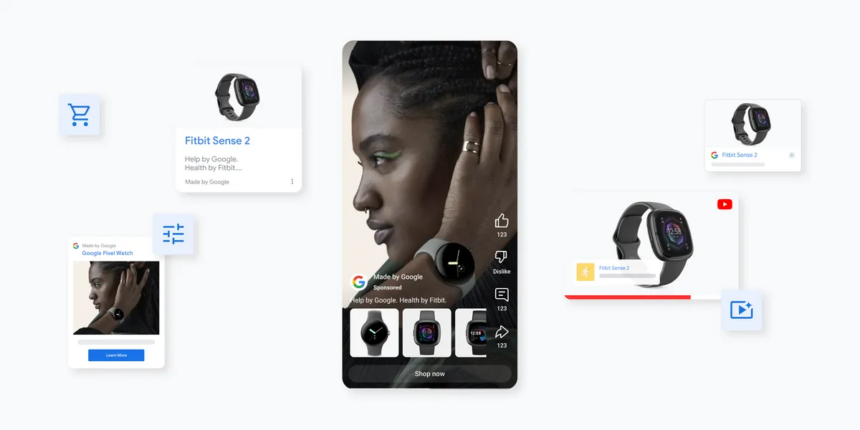
Google Ads launched this type of campaign in 2023 to replace Google Discovery. Demand Gen campaigns are designed to generate demand and capture the attention of users on various Google platforms, such as YouTube, Gmail, Discover and Display, without them necessarily having searched for the brand name or its products.
For example, a brand of smartwatches designed for sports can target users who have recently viewed articles about running, watched YouTube videos on the subject, or visited a competitor’s website. Once targeted, users could see an advert for the smartwatch on Shorts, an advert integrated into the Discover feed, or a promotional message offering a special deal in their Gmail inbox. It is also possible to use Demand Gen campaigns for retargeting, by retargeting users who have already interacted with the brand in the past.
New options to boost demand generation
Demand Gen campaigns have obvious potential, particularly as they compete with Meta Ads campaigns through their ability to reach users at the top and middle of the conversion funnel. However, these campaigns, launched in 2023, do not seem to be meeting with the expected success among advertisers at this stage. In an attempt to change this, Google recently unveiled new features.
Better control over campaign distribution
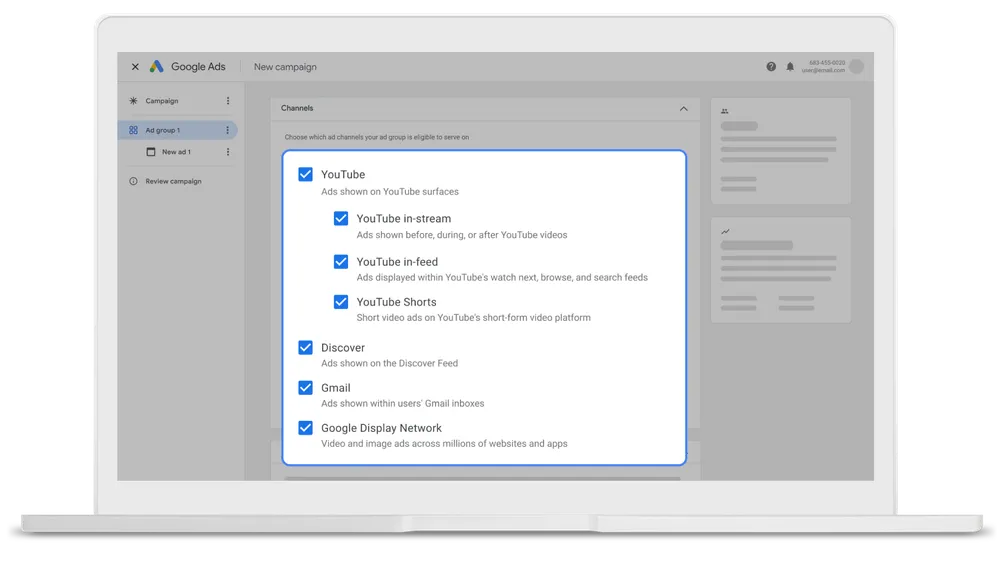
In future, advertisers will have greater control over the channels used by their Demand Gen campaigns. Although still optimised by artificial intelligence, these campaigns can now be limited to certain channels in Google’s inventory. In addition, the American giant has announced the addition of Google Display to this, allowing advertisers to also broadcast this immersive content on numerous websites and applications.
New creative tools to enhance assets
Recognising the importance of assets in driving campaign performance, Google Ads now offers several new tools to facilitate the creation of engaging visual content. In particular, the platform has opened up the field to 9:16 vertical image ads on Shorts and announced the arrival of a new feature that allows users to create shorter versions from longer videos.
A more in-depth performance analysis
Not only will advertisers now be able to use the most effective formats to generate demand and capture new leads, but it will also be more convenient and intuitive to analyse the performance of these campaigns. Google Ads has introduced new reporting columns to help advertisers make the best decisions about budget allocation.
Campaigns compatible with Performance Max
These new features demonstrate Google Ads’ desire to encourage advertisers to invest in this type of campaign. This is especially true given that these campaigns are particularly compatible with Performance Max, which Google has been promoting since its launch in late 2021.
Demand Gen campaigns attract new prospects and raise awareness of an offer, while Performance Max campaigns capture purchase intent and drive conversions. Demand Gen campaigns reach users at the top and middle of the conversion funnel to feed remarketing audiences, while Performance Max campaigns capture them and push them to take action. This complementarity is also useful for limiting advertising expenditure, with lower-cost lead generation on Demand Gen, followed by maximising conversions from these prospects using Performance Max.
Would you like to learn more about Demand Gen campaigns and integrate them into your strategy? Feel free to contact our Google Ads agency.
The rollout of Mix Experiments in beta marks a decisive step forward in the automation of media buying on Google Ads. This cross-campaign testing feature finally allows advertisers to break down technical silos and allocate their budgets based on real incrementality, rather than sector-specific intuition. Towards the end of silos: data-dr...
With Google Ads audiences of 100 users, Google is redefining the rules of advertising targeting. Until now, activating audiences required high volumes, which were often incompatible with the realities of SMEs, B2B players, or niche markets. By lowering the minimum threshold to 100 users, Google Ads is broadening access to remarketing and ...
Google recently reposted several support pages dedicated to Website Optimizer, a new tool that may soon appear in the “Reports” tab of Google Ads, connected to GA4. The name evokes the historic tool launched in 2008, which became Google Optimize before its disappearance in 2023, but initial indications suggest a completely red...
The suspension of a Google Ads account is one of the scenarios most feared by advertisers. A simple alert message can halt campaigns, impact revenue and keep teams busy for days trying to identify a cause that often turns out to be unclear. Over the past few months, the platform has rolled out several major […]...



 Pierre Blarre