Since Wednesday 22 July, Google’s AI Overviews and AI Mode have been available in France. At Ad’s up Consulting, we have been using and testing AI Overviews ever since their launch on the US market, to observe their tangible effects on SERPs. We then compared our initial feedback from the field with the most comprehensive market research currently available (Google data, Semji’s analysis of over 4,000 search queries and the Similarweb study on the impact of generative AI on traffic) in order to round out our analysis and provide you with the most reliable insights.
Generative AI is no longer a laboratory experiment. In the space of a year, it has reshaped the gateway to information: Google provides answers directly at the top of the page, ChatGPT is capturing an increasing share of news-related queries, and internet users are clicking less and less. For brands, the challenge is no longer simply to be well-ranked, but to feature in the responses generated by language models. This article reviews the initial measurable impacts and explains how to secure visibility, both in SEO and SEA.
Key figures to bear in mind
Five months of observations are sufficient to identify four key indicators:
71.3 per cent of informational keywords do not trigger the display of AI Overviews.
6 per cent of transactional keywords display AI Overviews.
80 per cent similarity between the top three sources in AI Overviews and the top ten in SEO.
42 per cent of complex queries trigger the display of AI Overviews.
Google’s AIMode has surpassed 1 billion monthly active users; the average query on the platform is three times longer than a standard search (Google, 2026)
Source: AI Overviews: What are the initial impacts? – Semji study
The SERP landscape: before and after the roll-out of AI Overviews
The Semji study on search similarity in the US market, based on 1,000 informational keywords, highlights a clear trend between February and June 2024.
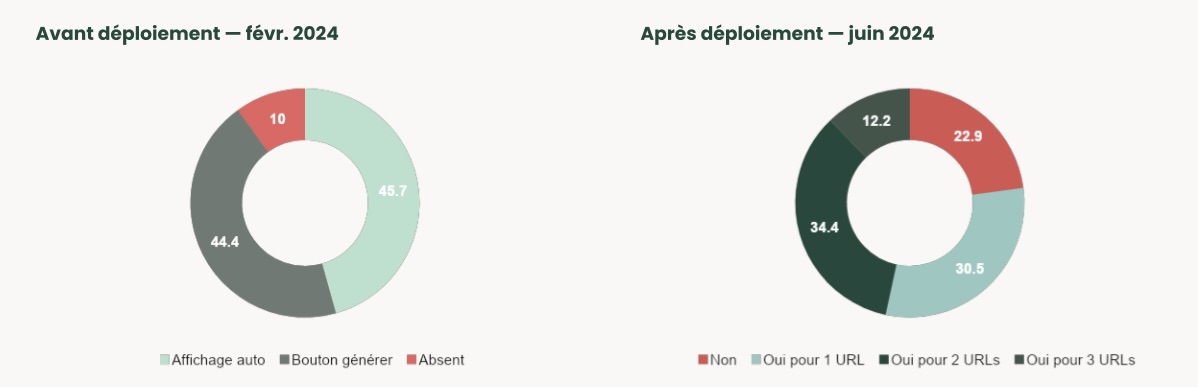
Prior to roll-out (February 2024): 45.7 per cent via automatic display, 44.4 per cent via a ‘generate’ button, 10 per cent no response. At that time, it was easy to distinguish the generated response from link cards, which helped drive organic traffic to the source sites.
Following its roll-out (June 2024), the metric focuses on the number of URLs cited: 22.9 per cent without citations, 30.5 per cent with one URL, 34.4 per cent with two URLs, and 12.2 per cent with three URLs. The new version reduces the number of direct links to source pages, which may limit redirection to the original sites.
The most striking finding: the proportion of informational queries handled by the feature fell from 90 per cent to 30 per cent in five months. In a counter-intuitive move, Google has scaled back its use of AI Overviews rather than expanding it. Experts do not attribute this drop to the subject matter, type or wording of the queries: it appears to be down to factors that have not yet been identified, likely internal trade-offs between cost, reliability and user satisfaction. It is worth noting that in 80 per cent of cases, the sources cited in the link cards already feature amongst the top 10 SEO results.
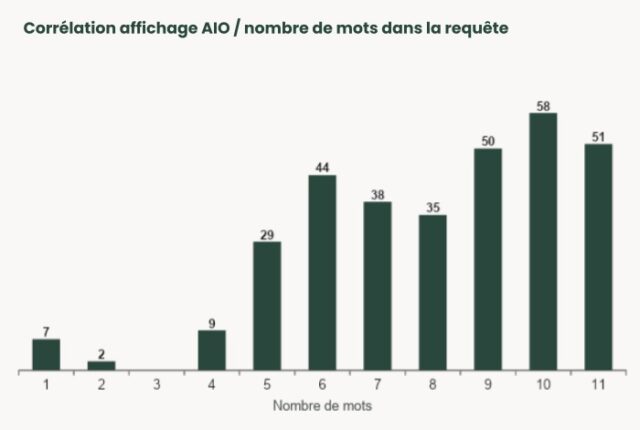
The topic alone does not explain everything: the length and wording of the query play a decisive role in triggering an AI Overview.
There is a correlation between query length and the likelihood of a result being displayed: short-tail keywords generate few AI responses, whilst long-tail queries (voiced) trigger more. This would appear to confirm Google’s focus on long-tail queries, which in turn validates the importance of long-tail strategies in standard SEO.
Continuing to focus on the long tail remains relevant, but it is the thematic mapping of your search queries that will determine your actual exposure to AI once the feature is live in France.
An AI that chooses its queries… and its sectors
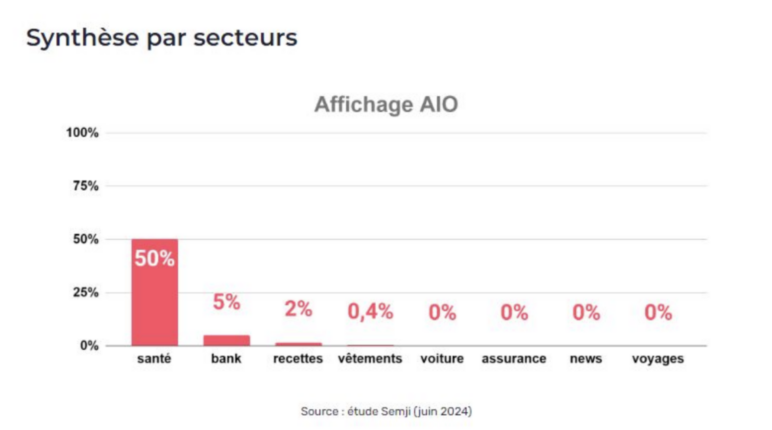
This is undoubtedly the most actionable analysis for preparing for the launch in France. AI Overviews does not trigger at random: it clearly favours certain sectors.
78 per cent of health-related technical enquiries (‘how to treat…’)
53 per cent of practical ‘how-to’ queries
50 per cent of health-related queries (excluding ‘how to treat’)
15 per cent of cooking-related queries containing a question
2 per cent of cooking-related queries (half of which are about… cooking eggs)
But it also gives priority to certain sectors.
Health. Whilst a European might expect Google to err on the side of caution, it is precisely on ‘how-to’ health queries that the AI is most vocal. Google is taking the gamble of using AI to address these queries rather than directing users to find the answers themselves. This selectivity appears to depend on the search behaviour of local users. This is something to monitor closely when the service is rolled out to the French market.
Cookery. Conversely, recipes generate virtually no responses, and specific technical queries (cooking times, pizza dough) peak at 15 per cent. There remains significant scope for organic traffic to this content.
Consumer spending. Transactional keywords do not generate any AI responses: they return a standard SERP, with sponsored and organic results. Combined with the absence of advertising on AIO at launch, this is a reassuring short-term signal for e-commerce and paid acquisition.
AI Mode is reshaping the landscape of search intent
AI Mode, which combines the speed of Search with the reasoning capabilities of the Gemini models, confirms that search is not merely being enhanced with a summary: it is undergoing a transformation. Google sees this as the most significant transformation in the history of search. The US data speaks for itself (Google, May 2026):
Over 1 million monthly active users worldwide.
AI Mode queries have doubled every quarter since the launch.
The average query is three times longer than a standard search.
One in six searches is non-textual (voice, image, video); image-based searches are growing by 40 per cent a month.
How is search behaviour changing?
People are no longer just searching more; they’re searching differently: longer questions phrased in natural language; the rise of multimodal search; follow-up conversations (follow-ups up by 40 per cent per month on average); and the end of the ‘correct’ way to phrase a query: people simply ask. The most frequently used first words show this: What, How, I, Is, Can.
The 5 uses of AI Mode
AI Mode doesn’t just change how we search, but what we search for and how we act afterwards:
Explore (discover & be inspired): brainstorming queries have grown 30 per cent faster than the overall figure since launch.
Decide (choose & decide): queries containing ‘which’ have grown 40 per cent faster over six months.
Learn (understand & revise): quizzes, revision sheets, in-depth guides: AI Mode acts as a personal tutor.
Create (create & generate): requests to create images have tripled since the start of the year.
Do (plan & act): planning requests are progressing 80 per cent faster over a six-month period.
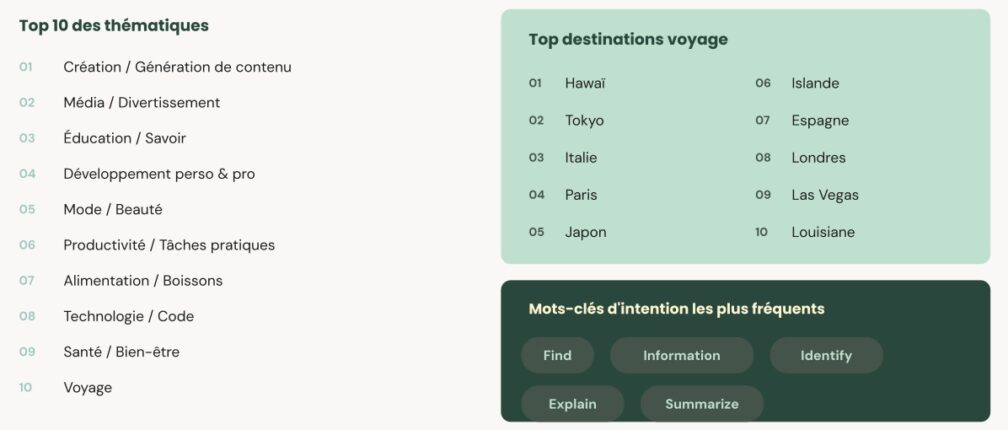
What people are looking for in AI Mode
Source: Google, ‘How AI Mode is changing the way people search in the US’, May 2026 (Google Trends data, May 2025 → April 2026).
SEO isn’t going away: it remains the gateway to AI sources
Good news for content strategies: out of 1,000 informational keywords analysed, 80 per cent of the sources cited in an AI Overviews already feature in the top 10 organic search results. In other words, traditional SEO remains the best way to be cited by AI.
The key factors remain the fundamentals of SEO, applied rigorously: a clear and concise answer right at the top of the page, short and readable paragraphs, essential information placed at the beginning, and a structure that makes it easy for the algorithm to process. The long tail, phrased as a spoken question, also increases the chances of triggering a result, but the topic carries more weight than the word count.
And what about the SEA in all this?
What SEA is going through today, SEO has already been through. In just a few years, organic search has shifted from a focus on keywords and rankings to one centred on intent, entities and authority, to the point where it must now aim to be cited as a source in generative answers rather than simply appearing as a blue link. This shift has not worked against SEO: it has broadened its scope. The same trend is now beginning to take hold in paid search.
Because advertising always follows attention. And attention is shifting towards AI platforms: AI Overviews, AI Mode, conversational assistants. The SEA of the future will not disappear, but it will change in terms of its platforms and approach, just as SEO has shifted its focus without losing its raison d’être.
Two disciplines are emerging at the cusp of this shift, and are already shaping the support we provide:
GEO (Generative Engine Optimisation) builds on SEO: it involves optimising your content and authority so that you are cited and recommended by generative engines (Google AI, ChatGPT, Gemini, Perplexity, etc.). It is the natural extension of organic work in a world of answers rather than results.
GEA (Generative Engine Advertising) builds on SEA: it involves buying visibility within AI-generated responses themselves, as ad networks open up this inventory. This is a new frontier, where advertisers who experiment early will gain a head start, just as the first Google Ads advertisers did in their day.
Key takeaways
Since 22 July, Google has rolled out AI Overviews in France. There is one key point to bear in mind when preparing for this: AI Overviews do not provide answers to transactional queries, and no adverts will appear there at launch. E-commerce acquisition is, for the time being, unaffected.
Search is entering a hybrid phase. Generative AI captures information and reduces the need for clicks, but transactional intent – and therefore SEA – remains, for the time being, within a traditional and controlled framework. The winners will be those brands that stop thinking in silos: securing conversions through paid search, defending their presence in AI-driven sources via rigorous SEO, and investing early in GEO to remain visible in generative responses. Roll-out in France is still in its early stages: now is the time to adapt your strategy, not to be at the mercy of it.
Would you like to prepare for the arrival of AI Overviews and AI Mode as part of your Google Ads strategy? Our Google Ads agency can help you adapt your SEA approach to these new AI-driven search experiences right now.
Google is expanding its Chrome User Experience Report (CrUX) with four new advertising metrics. The aim is to measure more accurately the actual advertising pressure experienced by internet users. For advertisers, this development could provide a new way of assessing the quality of display and programmatic inventory. However, these metric...
Is your Google Ads budget melting away faster than an ice cream in the middle of August 🍦☀️, whilst your sales aren’t keeping pace? You’re not alone. Between Search, Shopping, Performance Max and AI-driven auctions, managing your e-commerce campaigns in-house (or with an agency that isn’t really specialised) can quickly become a headache....
The Google Ads AI Max migration will reach a significant milestone from September 2026. Google will begin automatically converting certain Search campaigns that use automatically generated ad groups or broad match at campaign level. DSA campaigns, meanwhile, have until February 2027. For advertisers, the immediate priority is therefore to...
Is your Google Ads budget disappearing as fast as a bank holiday in the middle of the week? Like Marine Léonardi, you’re not alone. Between Search, Shopping, Performance Max and AI-driven auctions, managing your campaigns in-house can quickly go pear-shaped and leave you feeling drained. And yet, a competent Google Ads agency can transfor...