On 17 August 2026, Google is changing the way its Google Ads target-based auctions work. This is a subtle change in wording, but one that could have a significant impact on the profitability of your campaigns. This is particularly true if your budgets are tight and your targets do not reflect your actual performance.
Here’s what you need to know, and how to prepare for this update before it affects your results.
Background: why is Google changing its auction system?
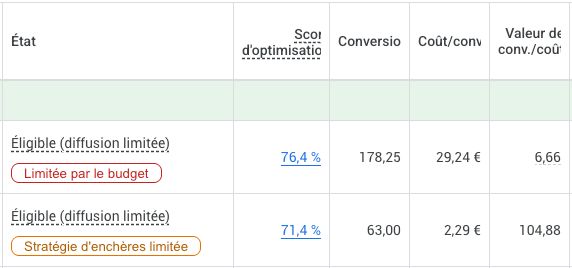
Currently, when a campaign has the status “Budget-constrained” and uses a target-based bidding strategy (tCPA, tROAS, Maximise Conversions or Maximise Conversion Value with Target), the system may sometimes deliver performance below the defined target – that is, at a lower CPA or a higher ROAS than the advertiser requested.
However, whilst this approach appeared to be advantageous, it came at a cost: unpredictable fluctuations in performance during budget adjustments. Advertisers thus found that their KPIs took a sudden nosedive simply after changing their budget.
Google is addressing this confusion with an update that tightens the system’s rules: from 17 August, the campaigns in question will optimise more consistently towards the target entered, even when budget is limited.
Target-based bidding strategies: what will change after 17 August 2026
Before the update
A budget-constrained campaign with a tCPA of €10 has historically been able to deliver an actual CPA of €5. The system makes the most of the most profitable opportunities available within the budget, sometimes well below the theoretical target.
After the update
This same system will adjust its delivery to align with the stated target. A campaign with a tCPA of €10 that was performing at €5 will start delivering at around €10. Without adjusting your target, your campaign may gradually converge towards the CPA or ROAS set for the campaign, which may result in a drop in observed efficiency if your current performance is significantly better than this target.
Google will not automatically adjust your targets or budgets. The responsibility for making any adjustments lies entirely with the advertiser or agency.
Which campaigns are affected?
The update applies to the following campaign types: Search, Shopping, Performance Max, Demand Gen, Display and Travel. Hotel and Display campaigns already partially incorporate this behaviour.
This change does not affect App Campaigns, Video Reach Campaigns and Video View Campaigns (VVC), which will continue to use the previous bidding behaviour.
The update is now live across all platforms: Google Ads, Search Ads 360, Display & Video 360, Google Ads Editor and the Google Ads API.
A specific impact on multi-channel campaigns
For Performance Max and Demand Gen campaigns in particular, Google states that this change may also lead to alterations in the distribution of traffic across the various channels. Advertisers running PMax campaigns with tight ROAS targets will need to be particularly vigilant in this regard.
The Bid Target Adjustment Tool: the new preparation tool
From 6 July 2026, Google will be making a new tool available in the Google Ads interface: the Bid Target Adjustment Tool. It allows you to view the gap between the stated target and the historical performance of each eligible campaign, and to apply a target adjustment aligned with recent actual performance with a single click.
Google will send notifications directly to the accounts concerned. That is, accounts that have had at least one ‘Budget-limited’ campaign over the last 12 months using a target strategy.
Action scenarios for your Google Ads target-based auctions
Scenario 1: Your targets already reflect your actual business objectives
No action is required in relation to the targets. The system will simply become more consistent in achieving the set objective. You may wish to consider increasing the budget to capture greater volume at this target profitability, given the improved predictability.
Scenario 2: Your campaigns are outperforming their stated targets
This is the highest-risk scenario. If your tCPA is €10 but your campaigns are delivering at €5, the update will automatically reduce your performance unless you readjust the target. Recommended action: use the Bid Target Adjustment Tool from 6 July onwards to align the target with recent performance, or manually set a target that is consistent with your actual business objectives.
Scenario 3: You want to set an interim target
Google allows you to set a custom target, independent of historical performance. For example: your tCPA is €10, your actual CPA is €5, but €7 is your optimal break-even point. You can enter this value into the tool and the system will adjust to this new target after 17 August.
Scenario 4: You prefer to switch to a strategy without a target
Switching to ‘Maximise Conversions’ or ‘Maximise Conversion Value (no target)’ allows you to maintain volume whilst letting the system spend the entire budget. However, the CPA or ROAS will no longer be guaranteed and will fluctuate in line with budget adjustments.
What this change reveals about the management of automated auctions
This update sends a clear message: the precision of the targets set in bidding strategies is no longer a mere formality. That is why, in a Google Ads bidding system that now optimises more strictly towards the declared target, an incorrectly calibrated setting directly jeopardises performance.
For agencies and media teams, this change underscores the importance of two practices: regularly reviewing the gap between stated targets and actual performance, and proactively updating targets as performance changes, rather than allowing the system to passively absorb this gap.
Checklist for target-based bidding strategies: what to do before 17 August 2026?
Identify campaigns with the status "Budget-limited" that are using a target-based strategy (tCPA, tROAS, Max. conversions with target, Max. conversion value with target)
Measure the gap between the stated target and actual performance over the last 30 to 90 days
Prioritise the campaigns where the gap is the most significant
Use the Bid Target Adjustment Tool from 6 July to review your bid targets in a documented manner
Document the adjustments made to facilitate the analysis of changes following 17 August
Our Google Ads agency supports you in adapting your Search, SEA and content strategies to the era of AI interfaces, to identify new drivers of performance and build sustainable strategies in response to changes in Search.
FAQ
Which campaigns are excluded from this update? App Campaigns, Video Reach Campaigns and Video View Campaigns (VVC) are not affected and will continue to use the current bidding behaviour.
Will Google automatically change my targets or budgets? No. Google will not make any automatic adjustments. It is the advertiser or their agency’s responsibility to review and update these.
When will the Bid Target Adjustment Tool be available? The tool will be available in Google Ads from 6 July 2026. This is approximately six weeks before the change comes into effect.
Will a campaign that is outperforming its target inevitably start to underperform? In most cases, yes. If your campaign is currently performing significantly better than the specified target and no adjustments are made, it should gradually converge towards that target.
Does this change affect Performance Max campaigns? Yes. PMax is included, with one further caveat: Google may also redistribute traffic across channels
What happens if I increase my budget after 17 August? Unlike what might have happened previously, budget increases after 17 August should no longer cause fluctuations in performance. The system will consistently optimise towards the target, regardless of the budget level.
Longer sales cycles, sometimes high CPCs, limited audiences – welcome to the cut-throat world of a B2B Google Ads campaign, which, to make matters worse, isn’t managed in the same way as an e-commerce campaign. The aim here is to generate genuinely qualified leads to turn your media budget into real business opportunities. Quality over [&...
Google is expanding its Chrome User Experience Report (CrUX) with four new advertising metrics. The aim is to measure more accurately the actual advertising pressure experienced by internet users. For advertisers, this development could provide a new way of assessing the quality of display and programmatic inventory. However, these metric...
Is your Google Ads budget melting away faster than an ice cream in the middle of August 🍦☀️, whilst your sales aren’t keeping pace? You’re not alone. Between Search, Shopping, Performance Max and AI-driven auctions, managing your e-commerce campaigns in-house (or with an agency that isn’t really specialised) can quickly become a headache....
The Google Ads AI Max migration will reach a significant milestone from September 2026. Google will begin automatically converting certain Search campaigns that use automatically generated ad groups or broad match at campaign level. DSA campaigns, meanwhile, have until February 2027. For advertisers, the immediate priority is therefore to...